
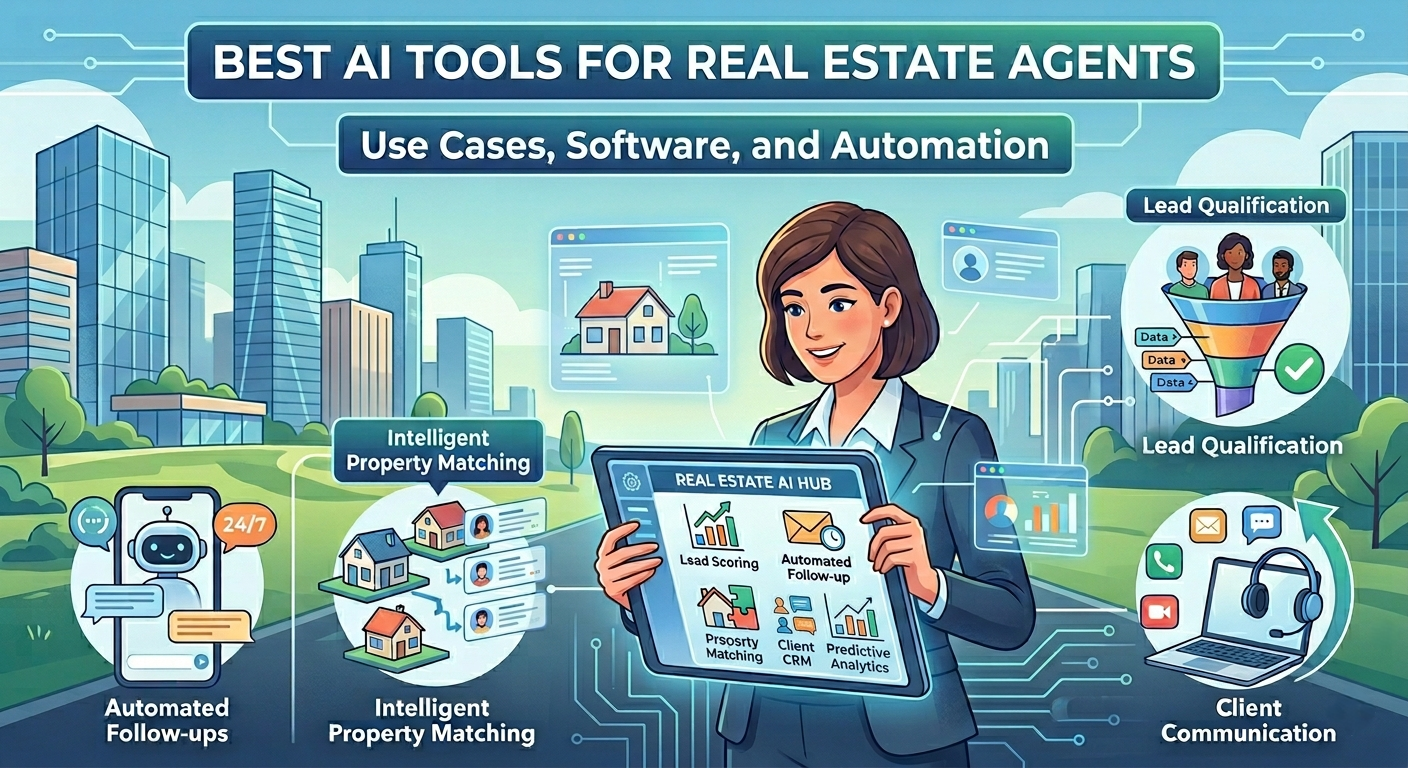
AI in real estate has moved well past the experimental stage. Agencies now run AI-powered lead qualification, automated follow-ups, intelligent property matching, and around-the-clock client communication without adding headcount. This guide covers what real estate AI software actually does, which tool categories matter most, and how agencies build custom solutions that fit existing workflows.
What Is AI in Real Estate?
Artificial intelligence in real estate refers to software that processes data, recognizes patterns, and executes tasks that would otherwise require human attention. In practice, this means scoring incoming leads, answering buyer inquiries at any hour, and keeping CRM records current without manual input.
Core AI Technologies Used in Real Estate
Several underlying technologies appear across most real estate AI applications:
- Natural language processing (NLP) powers chatbots, voice assistants, and automated email responses
- Machine learning drives predictive pricing models and investment analytics
- Computer vision enables automated property photo tagging and virtual staging tools
- Recommendation algorithms match buyers to listings based on browsing behavior and search history
These components often appear together inside a single platform or integration stack. Understanding which technology handles which task helps agencies evaluate tools more accurately.
Why Real Estate Businesses Are Investing in AI
The main driver is workload distribution. Agents spend significant time on repetitive tasks: answering the same questions, updating CRM entries, following up with cold leads, and scheduling viewings. AI tools handle that volume so agents can focus on closing deals and building client relationships.
Cost reduction plays a secondary role. Neurotrack’s AI solutions for a real estate agency can meaningfully reduce inbound support costs. The chatbot handles routine inquiries around the clock without operator involvement.
How AI Is Used in Real Estate Operations
AI automation for real estate covers five main application areas. Each one targets a specific workflow bottleneck.
1. AI for Lead Generation and Qualification
AI lead generation real estate tools analyze website visitors, form submissions, and ad interactions to score prospects by purchase intent. A buyer who has viewed 12 listings in a specific price range signals differently from someone who clicked one ad and bounced.
This scoring connects directly to CRM workflows. High-intent leads receive immediate follow-up sequences. Low-scoring contacts move into nurture tracks without any manual sorting from the team. The result is fewer leads lost to delayed contact and a more consistent conversion pipeline.
2. AI Property Recommendations
Recommendation engines match buyers to listings based on search history, saved properties, and stated preferences. When a buyer views several three-bedroom apartments in a specific district, the system surfaces comparable listings and alerts the assigned agent to follow up.
This reduces the time agents spend manually matching buyer criteria against available inventory, especially useful for agencies managing large listing portfolios.
3. AI Chatbots and Virtual Assistants
An AI chatbot for real estate handles first-contact inquiries at any time of day. Buyers ask about listing availability, neighborhood details, pricing ranges, and viewing schedules. The chatbot answers immediately, collects contact information, and escalates to a human agent when the conversation requires it.
An AI assistant for real estate agents also extends to voice. Neurotrack’s AI voice consultant works as an AI voice assistant for real estate. It handles inbound calls, answers questions about active listings, and routes complex requests to the right team member. This reduces the number of calls requiring live operator time, which is particularly valuable during evenings and weekends.
4. AI for CRM Automation
AI CRM for real estate maintains accurate contact records without manual data entry. Every call, email, and chat interaction gets logged automatically. Follow-up reminders fire based on the contact’s actual behavior, not a fixed schedule. If a buyer visits three listings in one week, the system surfaces that activity and triggers a check-in from the assigned agent.
For agencies managing hundreds of active contacts, this kind of real estate automation software prevents leads from going cold and keeps every client relationship current.
5. AI Market Analysis and Forecasting
Predictive analytics tools process historical sales data, local economic indicators, and current listing activity to model pricing direction. Agents use these forecasts to advise clients on offer timing and investment decisions. Property managers apply similar tools to rental pricing, adjusting rates based on seasonal demand and comparable unit availability.
This category of real estate AI software is especially relevant for agencies in fast-moving markets. Pricing decisions there benefit from data analysis that goes beyond recent comparable sales.
Best AI Tools for Real Estate Agents
Choosing the best AI for real estate depends on which workflow gaps cost the most time. Most agencies organize their stack across four categories.
AI Marketing Tools
These tools automate property promotion and buyer outreach so agents spend less time on campaign management:
- Automated ad copy generation and A/B testing for property campaigns
- Email sequence builders with behavioral triggers based on listing views
- Social media scheduling connected to listing feeds
AI CRM Platforms
AI CRM platforms keep contact records accurate and follow-up consistent without manual effort:
- Predictive lead scoring based on engagement signals
- Automated contact segmentation by buyer stage and property interest
- Activity-based follow-up triggers linked to CRM events
AI Communication Tools
These handle first-contact and ongoing communication across multiple channels:
- Chatbots for website, WhatsApp, and Facebook Messenger
- Voice AI for inbound call handling and appointment scheduling
- Automated SMS and email follow-up sequences
AI Analytics and Reporting Tools
Reporting tools surface market data and performance metrics without manual compilation:
- Market trend dashboards for specific zip codes or districts
- Portfolio performance reports generated on a scheduled basis
- Conversion tracking broken down by lead source and agent
Real Estate AI Software for Agencies and Enterprises
Larger agencies often find that off-the-shelf AI real estate software does not integrate cleanly with existing systems or match specific workflows. AI solutions for real estate agencies at this scale typically need to be built or configured to spec.
Custom AI Solutions
Neurotrack builds custom AI solutions specifically for real estate agencies, covering chatbots trained on a specific property database, lead scoring models built on the agency’s own historical conversion data, and automated reporting systems pulling from multiple data sources. The advantage over generic tools is precision: the AI operates on your listings, your client segments, and your proven conversion patterns. You can learn more about custom AI chatbot development as a starting point for client support automation.
Custom solutions also allow for tighter compliance with data handling requirements, which matters for agencies working with enterprise clients or operating in regulated markets.
AI Integrations with CRM and ERP
Connecting AI tools to existing CRM and ERP systems is often where the most operational value gets created. Real-time data flow between a chatbot, a CRM, and a property management platform means every team member has current information without manual syncing between tools.
For agencies using systems such as Bitrix24, HubSpot, or Salesforce, AI integrations add intelligent automation on top of existing data infrastructure. The agency gains meaningful automation capabilities without a full platform migration.
Workflow Automation
Real estate workflow automation handles repeating sequences: sending listing alerts when new properties match a buyer’s saved criteria, generating market reports on a weekly schedule, and updating contact statuses after viewings are completed. These automations run without human input, which reduces administrative errors and frees up time that currently goes to manual coordination.
Benefits of Using AI for Real Estate
The operational gains are measurable and specific. PwC’s Emerging Trends in Real Estate report identifies AI adoption as a primary force reshaping how real estate firms compete. Key gains include:
- Faster response times. AI chatbots respond to inquiries immediately. Human follow-up, in practice, often takes several hours.
- Higher lead conversion. Qualified leads contacted within minutes convert at significantly higher rates than those reached the following day.
- Reduced operator workload. Automating routine communication and data entry lowers per-transaction labor costs across the team.
- Better data quality. Automated logging produces more consistent CRM records than manual entry, which tends to be incomplete or delayed.
- Scalability without added headcount. An AI-powered communication system handles the same inquiry volume whether there are 10 active prospects or 500.
Working with Neurotrack on Real Estate AI
Neurotrack builds AI powered real estate solutions for agencies, property management companies, and brokerage networks. The team maps current workflows, identifies automation gaps, and deploys chatbots, voice systems, and CRM integrations that connect with existing tools. Explore custom AI chatbot development for client support or an AI voice consultant for inbound call handling.
Challenges of AI Adoption in Real Estate
Adoption comes with practical obstacles. Data quality is the most common: AI tools perform poorly when the underlying CRM data is incomplete or inconsistent. Integration with legacy property management systems can also require custom development work. Agents who see AI tools as a threat to their role tend to underuse them, which limits returns.
The Future of AI in Real Estate
The near-term direction is toward deeper personalization and proactive outreach. Recommendation systems are improving at predicting when a buyer is close to a decision and which properties fit. Voice AI is expanding from inbound call handling into outbound follow-up. AI digital real estate tools are also beginning to automate listing presentation and virtual staging. A McKinsey analysis of agentic AI in real estate notes that the shift is moving from AI that helps teams understand data toward AI that actively completes multistep workflows. Agencies building AI real estate platform infrastructure now are setting up a foundation for more advanced automation as the tools develop.
Conclusion
AI tools for real estate are most effective when they address a specific operational problem: slow lead response, inconsistent CRM data, high support call volume, or manual workflow coordination. Agencies that start with one well-defined use case, measure the results, and expand from there tend to see better outcomes. The technology works best as a complement to experienced agents. It handles the repetitive load so the team can focus on the work that actually closes deals.


