
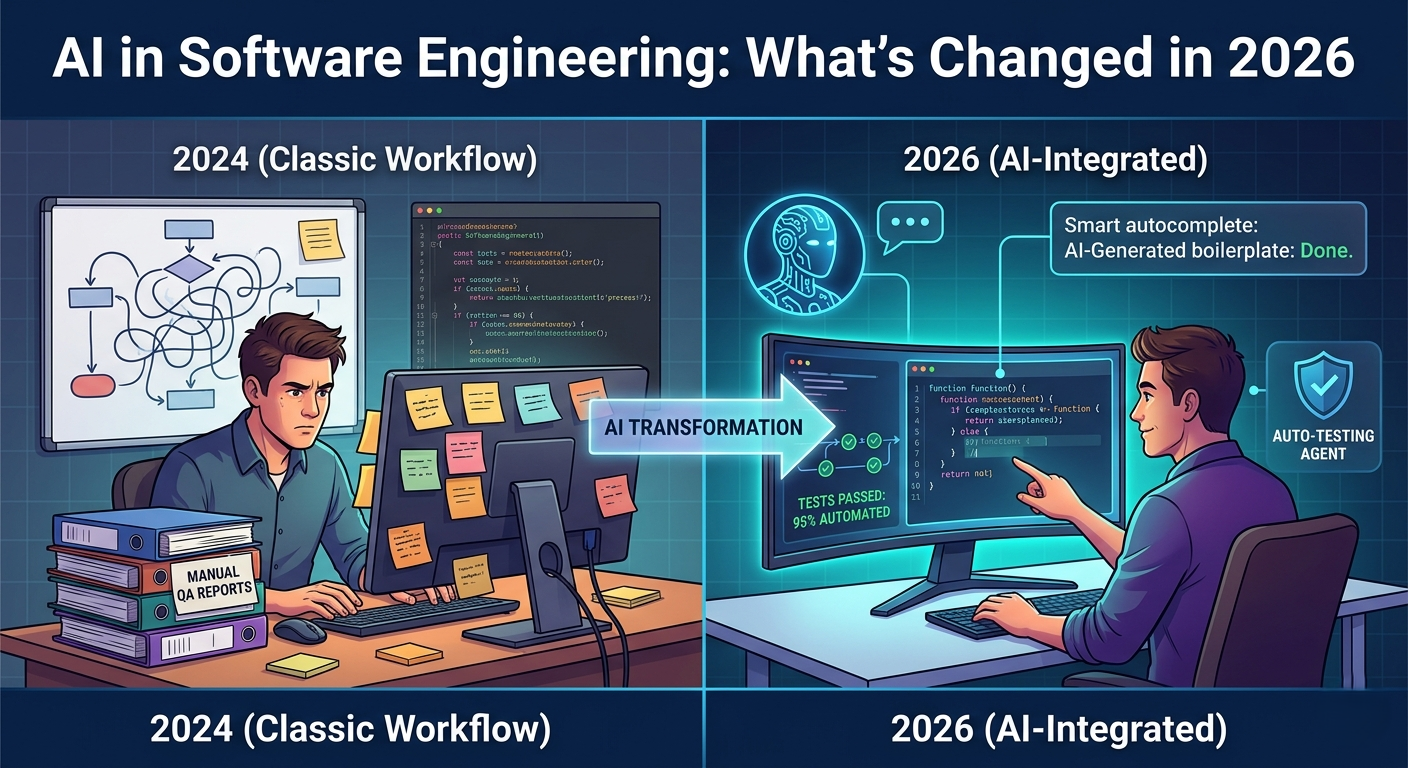
Software development teams are shipping faster, testing less manually, and writing less boilerplate than they were two years ago. AI coding assistants, generative AI models, and automated testing tools are now embedded in standard engineering workflows at companies of all sizes.
How is AI changing software development in day-to-day practice? The answer covers every phase of the development lifecycle. This article covers which changes are already delivering results, how engineering roles are evolving, and what organizations need to do to capture those gains.
How AI Is Transforming Software Development in 2026
AI in software development has moved well past the pilot stage. It is now standard workflow at engineering teams across industries. GitHub Copilot grew from 1.3 million paid subscribers in early 2024 to 4.7 million by 2026, and is now deployed across 90% of Fortune 100 companies. Gartner forecasts that 90% of enterprise software engineers will use AI coding assistants by 2028, up from less than 14% in early 2024.
The productivity gains are documented. According to McKinsey research, developers can complete well-defined coding tasks up to twice as fast with AI assistance. A more recent McKinsey study found that top-performing teams reported 16–30% improvements in team productivity and time to market, alongside 31–45% improvements in software quality.
Enterprise adoption is accelerating for practical reasons. Development backlogs are expensive. Artificial intelligence software development tools are proven to compress delivery timelines, and engineering managers are now treating AI tool adoption as an operational priority.
What has shifted is not the nature of software engineering but how engineers distribute their working hours. More time on architecture decisions and product thinking. Less time on boilerplate code and manual test setup. For a practical look at what building AI-powered systems involves end to end, see our guide to AI voice assistant architecture and development.
Where AI Delivers the Biggest Value
AI for software development delivers measurable returns in several specific areas. Understanding each helps engineering managers make concrete decisions about where to invest first.
- Code generation. Large language models like GPT-4o and Claude generate functions, components, and boilerplate from natural language prompts. GitHub Copilot accounts for an average of 46% of committed code, with acceptance rates higher on well-defined, lower-complexity tasks.
- Test automation. AI writing code for unit tests, integration tests, and edge case coverage is one of the highest-ROI use cases in the development lifecycle. Test coverage improves significantly without adding QA headcount.
- Debugging. AI tools identify bugs, suggest fixes, and explain error causes in context. Junior developers in particular see a significant reduction in time spent diagnosing unfamiliar error patterns.
- Documentation. Generating inline comments, README files, and API documentation automatically is a low-risk, high-value starting point for most teams. Documentation quality and consistency tend to improve as a side effect.
- Code review assistance. AI-based software development tools now flag security vulnerabilities, performance issues, and inconsistent patterns during pull request review, before human reviewers engage.
The common thread is time compression. Tasks that previously required hours complete in minutes, and output quality holds or improves. For engineering teams exploring broader workflow automation, see how AI agents for business apply these same principles outside the codebase.
How Software Engineering Roles Are Changing
How is AI changing software development at the role level? The changes are significant but not in the direction most headlines suggest.
AI software engineer tools are not replacing human engineers. The role is becoming a hybrid: part traditional engineering, part AI-assisted decision-making. Developers who work effectively with AI tools are handling workloads that previously required larger teams. The output expectations for experienced engineers have risen, and the teams meeting those expectations are the ones that have built AI into their daily workflows.
The skill requirements for software engineers are moving in three directions:
- System design and architecture. AI handles implementation details well. Architectural decisions, capacity planning, and long-term maintainability remain human responsibilities.
- AI tool fluency. Prompt engineering, understanding model limitations, and knowing when to trust AI-generated output are becoming standard skills alongside version control and testing practices.
- Cross-functional communication. As AI handles more routine code execution, senior engineers spend more time on product discovery, stakeholder communication, and technical strategy.
Many organizations are now deploying an internal AI assistant for engineering teams to reduce the interruption load on senior developers, surfacing coding standards, architecture decisions, and institutional knowledge on demand.
AI in programming has not reduced demand for experienced engineers. It has raised the baseline output expected of everyone on the team.
Future of Software Engineering With AI
What is the future of software engineering? AI-driven development workflows will become the default at professional engineering organizations, much as cloud infrastructure and continuous integration did before them.
The future of software engineering with AI is built around collaboration between human engineers and AI systems at every project phase. Generative AI handles implementation work. Machine learning models surface patterns in large codebases. AI agents manage routine tasks such as dependency updates, test execution, and code formatting. Senior engineers focus on architecture, business logic, and decisions that require judgment.
Several patterns are already standard at leading engineering teams:
- AI agents operating autonomously on defined development tasks, such as writing tests for new functions or flagging pull requests that violate style guidelines
- Compressed cycle time from product specification to working software, driven by AI-assisted application development tooling
- Smaller core engineering teams with broader AI tooling, producing output previously associated with teams two or three times larger
Artificial intelligence application development is also expanding what software products can do. AI agents embedded in products are creating functionality categories that were not economically viable to build and maintain manually at scale.
How Businesses Can Adopt AI Successfully
The gap between organizations capturing AI productivity gains and those still running pilots is widening. The difference usually comes down to implementation approach.
Successful AI software development solutions adoption follows a consistent pattern:
- Start with high-frequency, low-risk use cases: code generation, documentation, and test writing. These deliver fast returns with minimal governance complexity.
- Expand into AI agents for routine engineering workflows such as CI/CD pipeline management, security scanning, and release note generation.
- Build toward custom AI development where standard tools do not fit the organization’s specific stack, security requirements, or development workflow.
The governance side matters equally. Clear policies around code review requirements, data handling, and acceptable use of AI-generated output separate teams that benefit from AI from those that accumulate new technical debt. Organizations that treat AI adoption as a workflow change with proper oversight consistently outperform those that treat it as a straightforward tool drop-in.
At Neurotrack, we work with engineering teams and business leaders to implement enterprise AI solutions that fit real organizational constraints. From AI agent development to custom tooling for development workflows, the focus is measurable output improvement.
Conclusion
Software development is not waiting for AI to mature. The tools are here, the productivity gains are documented, and the engineering teams capturing them are moving faster than those that have not adopted. AI handles implementation work. Engineers handle architecture, judgment, and product direction. That division of labor is now standard at high-performing teams. The question for most organizations is not whether to adopt AI-assisted development, but how quickly and how deliberately.


