How a cashierless store works: AI, smart fridges and micromarkets
Contents
- How it works: a purchase with no checkout in 30 seconds
- What actually "recognises" the product
- Where cashierless stores are placed
- Classic vending, smart fridge or micromarket
- What to consider before you launch
- Where AI fits and how Neurotrack helps
- Neuroshop: the group's ready-made solution
- Where to start
Picture a retail point that runs around the clock, has no queue at a checkout and needs no assistant on the floor. A customer walks up, takes what they need, and payment is charged on its own. That is a cashierless store, a format that in a few years moved from startup news into the offices, hotels and gyms next door.
Behind that search there is usually a plain business question: "Could I run one too?" An owner sees that a classic retail point runs into rent, opening hours and staff wages, and looks for a way to sell where keeping a full shop makes no sense.
Let's work through it without the jargon. First, how a cashierless store actually works and what the AI does inside. Then where these go and what formats exist. And the main part: what to weigh up before you launch, and where an AI developer is useful here.
How it works: a purchase with no checkout in 30 seconds
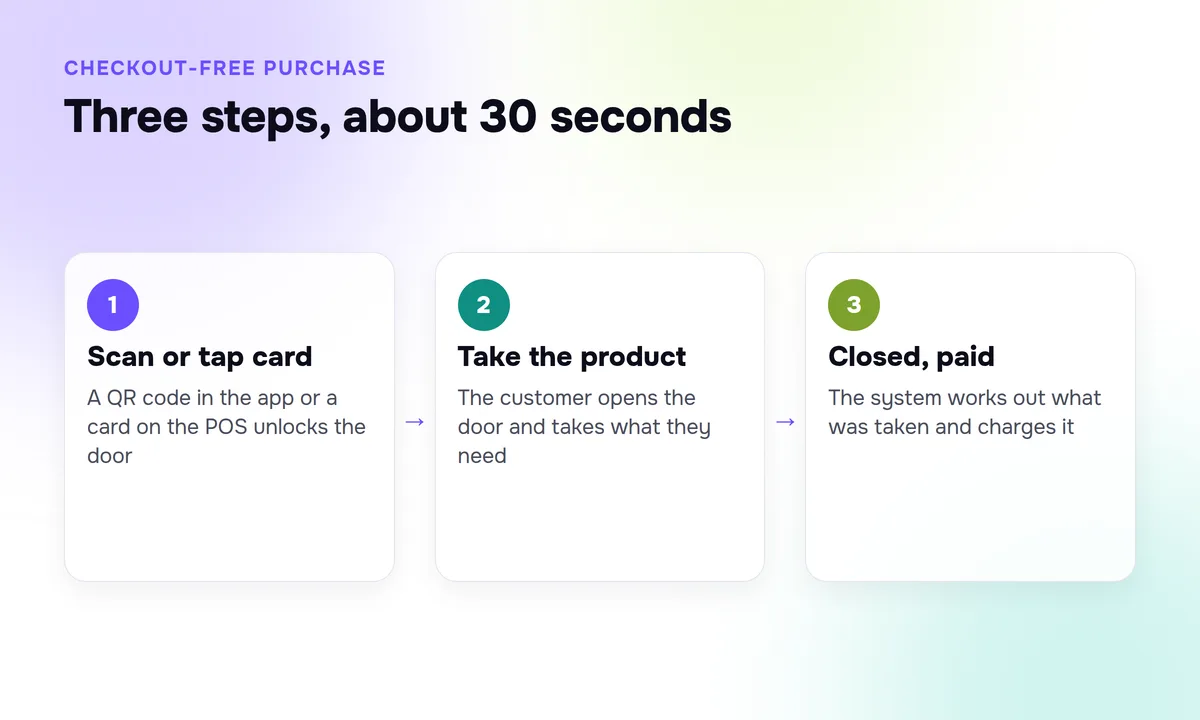
In a usual shop the goods are "seen" by a person at the till: they scan the barcode, add up the total, take payment. In a cashierless store the hardware takes that role. The purchase itself is short.
- The customer scans a QR code in an app or taps a bank card on a POS terminal to unlock the device.
- They open the door and take the products they want, just like from their own fridge at home.
- They close the door. The system works out what was taken and charges for it.
Neuroshop describes its hardware this way: "the micromarket detects what the user has taken and charges them automatically", and the whole purchase "takes about 30 seconds". There is no scanning of each item by hand. The shopper simply takes what they want and leaves.
What actually "recognises" the product
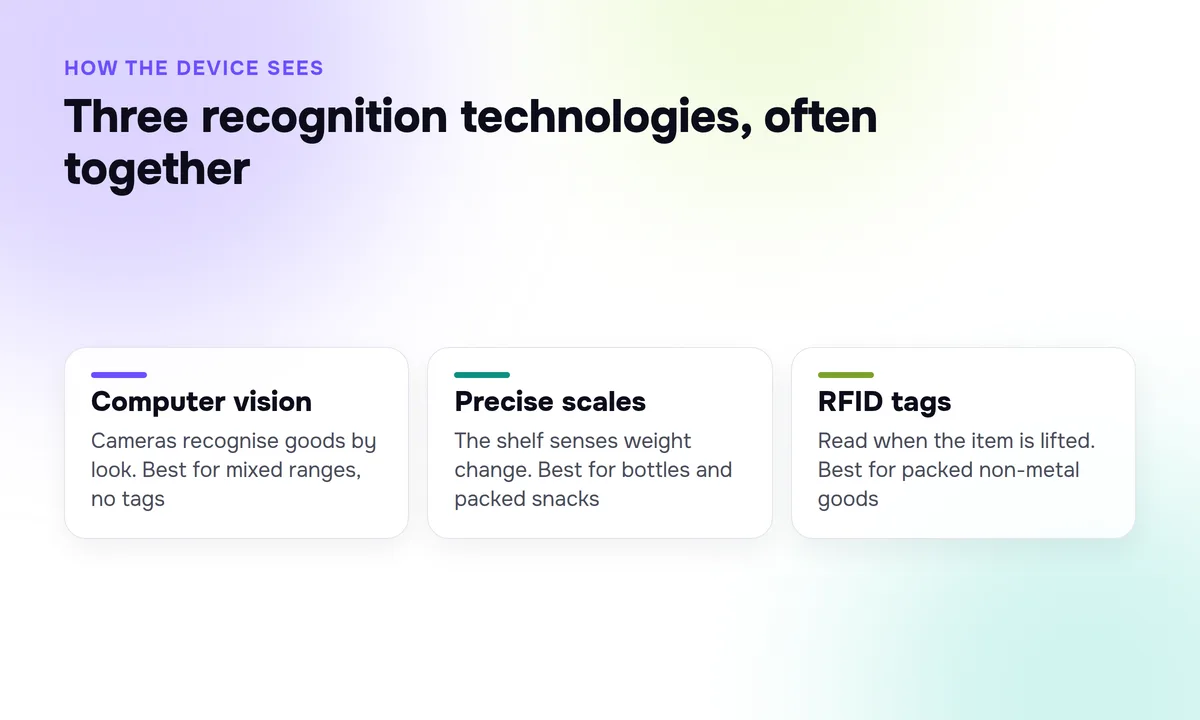
The key question for any cashierless format is how the device knows what was taken. Three technologies do the work here, often together.
- Computer vision (neural vision). Cameras inside recognise products by how they look. In Neuroshop's description, the system "uses advanced AI technologies and algorithms to track customer interactions and product choices" and "can tell different products apart". This is the same AI that means you do not have to stick a tag on every bottle.
- Precise scales. Shelves weigh the goods before and after a purchase. Even the smallest change in weight shows what was taken and how much. This suits items of a steady size, such as bottled drinks and packaged snacks.
- RFID tags. A radio-frequency sticker goes on the product, and the device reads it the moment the item is lifted out. It works accurately for packaged items in non-metal packaging: ready meals, sandwiches, salads.
Strip away the hardware and the idea is simple: a cashierless store replaces the person at the till with a mix of cameras, scales and tags, and the decision on what to charge is made by AI.
Where cashierless stores are placed
This unattended retail format pays off where there is a steady flow of people but a full staffed shop would not earn back its cost or simply would not fit. According to Neuroshop, the typical locations are:
- Offices, business centres and coworking spaces — a snack and a drink for staff without a trip outside.
- Hotels — round-the-clock access to food and drink instead of a minibar and a night reception.
- Gyms and entertainment venues — water, bars and sports nutrition next to the workout floor.
- Universities, colleges and schools — a quick bite between classes.
- Hospitals, clinics and wellness centres — food and drink for visitors and staff at any hour.
- Residential complexes and dormitories — a shop "near home" without renting a separate unit.
- High-traffic places — shopping centres, railway stations, airports.
What all these points share is one thing: people want to buy quickly and at any time, while keeping an assistant there is expensive or impossible. The devices run 24/7, so a cashierless store covers exactly the night hours and peak minutes when an ordinary point is either closed or has a queue.
Classic vending, smart fridge or micromarket
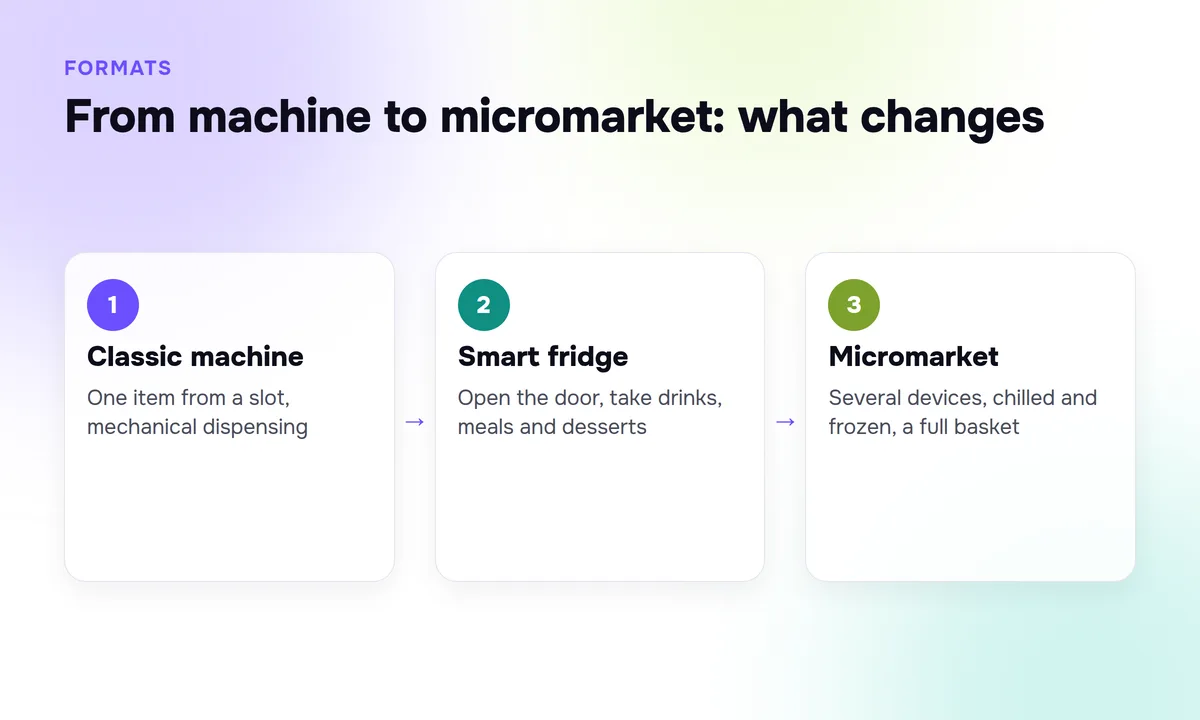
"Cashierless store" covers several different formats. They differ in how the customer takes the goods and what you can sell. Here is a summary by qualitative features, without prices.
| Feature | Classic vending machine | Smart fridge | Micromarket |
|---|---|---|---|
| How the customer takes goods | Picks a slot, the machine dispenses one item | Opens the door and takes from the shelf | Moves freely between several devices and takes what they want |
| Range | Limited by the slot shape | Ready meals, drinks, sandwiches, desserts | Wide: chilled, frozen, snacks, non-food |
| Product recognition | Mechanical dispensing | Cameras, scales, RFID | Cameras, scales, RFID across several devices |
| Items per visit | Mostly one item | A few per opening | A full "basket" in one visit |
| Temperature modes | Usually one | Chilled or frozen in one device | A mix of chilled, frozen and room-temperature zones |
| Where it fits | Busy passageways, one or two items | Offices, hotels, gyms, for fresh food | Large offices, business centres, malls, a full point |
In plain terms: a classic machine dispenses one thing, a smart fridge turns a familiar display into self-service, and a micromarket is already a small shop made of several devices, where the customer fills a whole basket. Neuroshop's line-up shows it in the hardware: smart fridges with a working temperature of 0…+8 °C for fresh meals and drinks, and separate freezer units with a mode down to −24 °C for ice cream and semi-prepared food. You can see a specific device on the smart fridge page.
What to consider before you launch
A cashierless store is not just a device but a retail point you have to think through. Here is a short checklist of what to sort out in advance.
- Location and traffic. Count not "how many people pass by" but how many of them will actually buy each day. That drives both the range and the number of devices.
- Range for the audience. In an office, lunches and coffee will sell; in a gym, water and bars; in a hotel, snacks and drinks round the clock. The right goods for the location matter more than their quantity.
- Payment method. For regular visitors (offices, gyms) an app with repeat purchases is handy; for one-off visitors (hotels, stations) a POS terminal with contactless, Apple Pay and Google Pay.
- Connection and device control. The device has to be online: to see stock, watch the temperature and spot a fault before the goods spoil. Telemetry handles this, with real-time monitoring of the equipment's condition.
- Protection against misuse. In a cashierless format this is a topic of its own: a pre-authorised amount on the card, a customer rating, extra sensors and surveillance cameras.
- Restocking and accounting. Someone has to top up the goods in time and reconcile sales with the books. The more points there are, the more it matters that this data is collected automatically rather than by hand.
The last two points, restocking and accounting, most often decide whether the format pays off at scale. That is exactly where work with data begins, and where AI is useful.
Where AI fits and how Neurotrack helps
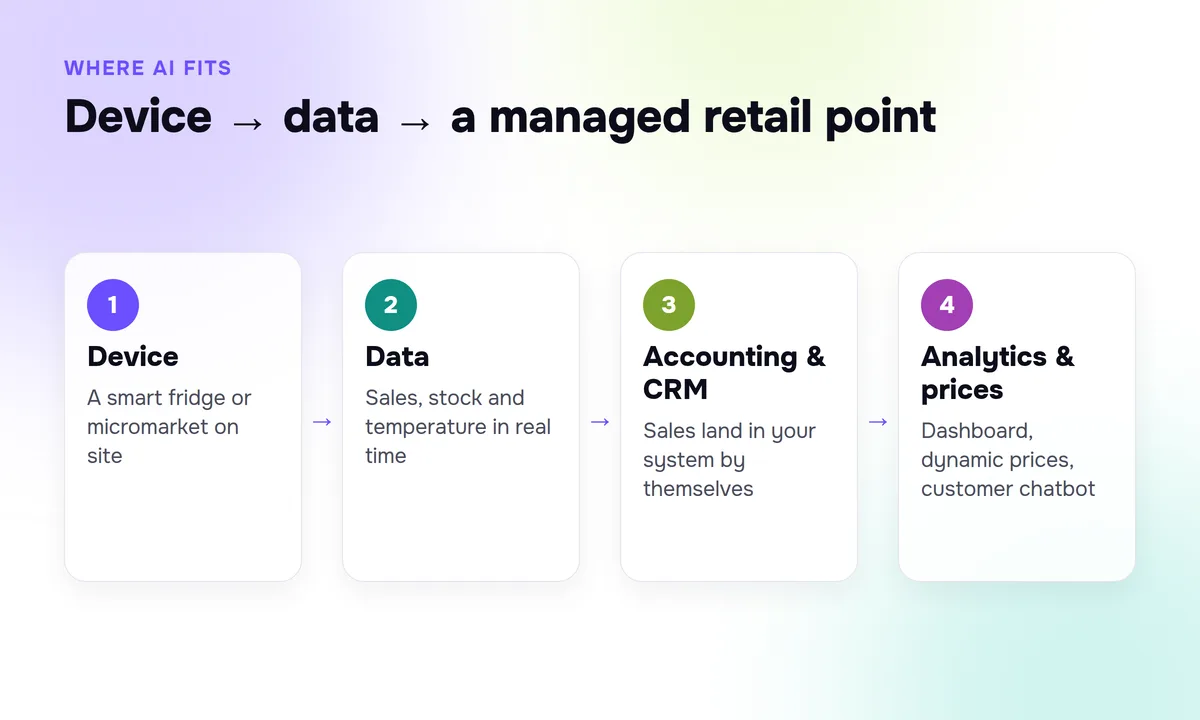
A device that takes payment is only the "shopfront". What makes a cashierless store profitable is what happens with the data behind it: how much of what sells, when to restock, at what price, how to answer customers. Neurotrack builds custom AI solutions and covers exactly this side of the retail point.
- Integration with accounting and CRM. Sales from the devices should land in your accounting system by themselves, not be retyped by hand. We set up integrations between CRM, ERP and external services so the data matches without manual transfer.
- Sales analytics. When there are several points, you need the whole picture: what is popular, where stock is running down and where goods are sitting. We build analytics and reporting that gathers the numbers on its own and shows them in a clear dashboard.
- Dynamic pricing. The price can change with demand, the time of day or the shelf life, and go straight to the electronic shelf labels. Set up in a controlled way, with limits on the margin, pricing never runs away on its own.
- Customer chatbot. Questions about payment, refunds or how the app works can be taken off your people. A chatbot for business answers around the clock and passes a hard case to an operator.
One big topic of its own is computer vision. The same technology that recognises goods inside a fridge works more widely too: it analyses video from cameras on the floor and watches shelf cleanliness, the presence of price tags and queues. If you need video analytics of the space beyond the device itself, Neurosensor handles that within the group.
Neuroshop: the group's ready-made solution
If Neurotrack covers the AI side, then the hardware for cashierless retail within the group comes from the sister project Neuroshop. It is a maker of smart devices for self-service retail.
The line-up includes smart fridges and freezer units, display cabinets, smart lockers and micromarkets assembled from these devices for a specific location. Product recognition is built on a mix of neural vision, scales and RFID; payment goes through a mobile app or a POS terminal with contactless payments. There are also separate modules useful for a network of points: electronic shelf labels on e-ink screens that update in seconds from an ERP or a control panel, telemetry for monitoring refrigeration equipment, and a computer vision system for keeping standards on the floor.
An important detail for business: the equipment is made in Ukraine. According to the maker, production is based in Kyiv, and for export to the EU "all the necessary certification and an established logistics chain are in place".
Together this gives a clear picture: Neuroshop is the devices and software for the retail point itself, Neurotrack is the AI integrations, analytics and automation around it, and Neurosensor is video analytics of the space. Three projects of one group cover different parts of a single task: making retail smarter and less dependent on manual work.
Where to start
A cashierless store is worth launching as an experiment: one point, a thought-through range, proper accounting, and real numbers for the first month instead of guesses. Once the format proves itself, you scale it to other locations.
If you want to understand where AI is useful in your case, from integrating devices with accounting to analytics and dynamic prices, request a free consultation. We will look at your task and tell you honestly what will really deliver and where a simple solution is enough.
FAQ
What is a cashierless store in plain words?
It is a retail point with no cashier and no assistant on the floor. The customer takes the goods from a smart fridge or micromarket themselves, and payment is charged automatically, based on the product being recognised by cameras, scales and tags. A person is needed only to restock in time and keep an eye on how the point is running.
How does a cashierless store know what I took?
Through several technologies at once: computer vision (cameras recognise the product by its look), precise scales (the shelf "feels" the change in weight) and RFID tags on the packaging. The decision on what to charge to the account is made by AI from these signals.
Do goods get stolen when there is no assistant?
The risk is minimised technically. According to Neuroshop, this means a pre-authorised amount on the card before the door opens, a customer rating system, extra motion and weight sensors, and surveillance cameras. The device logs every opening and any discrepancy.
How is a micromarket different from an ordinary vending machine?
A classic machine dispenses one item at a time from a limited set of slots. A micromarket is several smart devices (fridges, freezers, cabinets) where the customer freely gathers a whole basket of different goods, fresh meals included, and pays for it all at once.
Where do I get the equipment and who sets up the AI?
The equipment for cashierless retail within our group is made by Neuroshop. The AI side, from integrating devices with accounting and CRM to sales analytics, dynamic prices and customer chatbots, is handled by Neurotrack. The simplest way to start is a free consultation, where we look at your location and task.