Requests around the clock
Clients write and call at any hour, and there are never enough operators.
Solution · Security companies
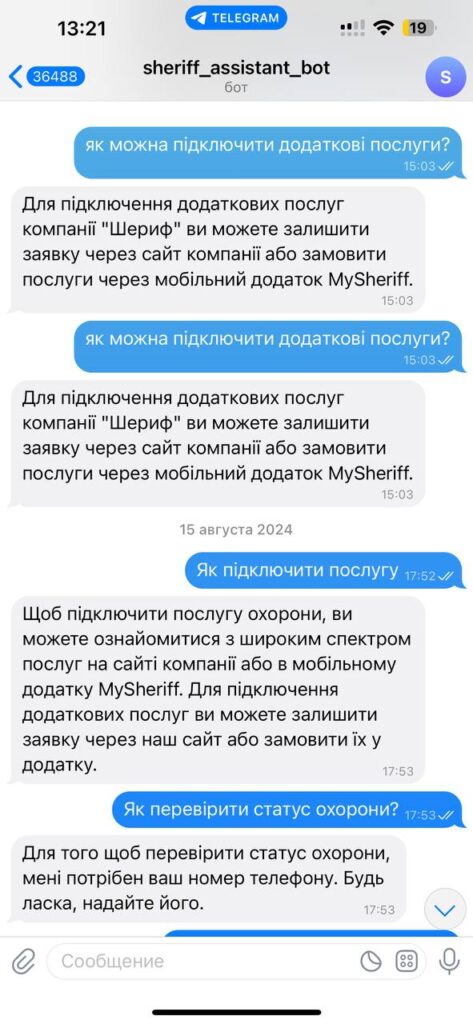
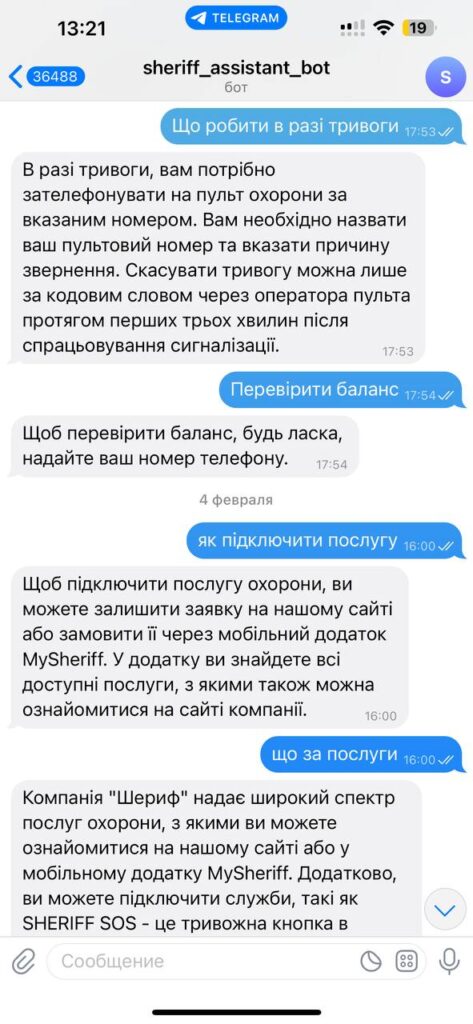
Security company clients get in touch when it matters: a balance, a site’s status, an alarm. A chatbot and a voice bot take these requests, recognize the client via your CRM and route emergencies to an operator.
In the security business, clients never call for nothing: an unclear invoice, an alarm that went off, a need to check that a site is armed. Requests arrive around the clock, and operators fall behind. The queue grows, and so does the client’s anxiety. AI support takes that pressure off across two channels. A chatbot handles written requests in a messenger, and a voice bot answers incoming calls. Both recognize the client via your CRM, show the balance and the status of protected sites in real time, and answer routine questions. In an emergency, the conversation moves to an operator instantly, with its context. It fits security companies, protection agencies and private security services. We built it from two Sheriff projects: the chatbot cut request handling time by up to 70%, and the voice bot reduced operator workload by up to 60% and made request handling three times faster.
The problem
Clients write and call at any hour, and there are never enough operators.
When an alarm goes off, the client should not be waiting on hold.
Operators spend time on routine balance and site status questions.
When the call moves to a person, the context of the request gets lost.
What you'll get
The bot handles both messenger chats and incoming calls.
Through the CRM it sees who is calling and pulls their details.
Shows payments and the protection status in real time.
Answers about services, contracts and invoices with no operator.
Routes a complex or alarm case to an operator with full context.
The client gets an answer at any hour.
What's included
Chat, telephony and clients’ routine questions.
Client recognition, balances and site status.
Written requests and replies in Telegram or another channel.
Answering incoming calls and replying by voice.
When the conversation goes to an operator with its context.
We test on your requests and support you after go-live.
Industries
The client checks their balance and site status in chat or by voice instead of waiting for an operator, as at Sheriff.
The bot closes routine requests; complex and alarm cases go straight to a person.
Round-the-clock client support without expanding the call center.
The voice bot takes the stream of identical calls off dispatchers.
Clients sort out payment and contract questions themselves in the channel they prefer.
Not every client writes to a chat; many call, especially when something feels wrong. The voice bot picks up the incoming call, answers by voice in real time and recognizes the client through the CRM, so the person does not have to read out a contract number.
The bot reads out the balance and the status of protected sites, answers routine questions, and routes a complex or emergency call to an operator right away, along with the context. At Sheriff, the voice bot reduced operator workload by up to 60%, and requests started being handled three times faster.
Responds to the client in real time without an operator.
Sees who is calling and pulls their details.
States payments and the protection status of sites.
An emergency or complex call goes to an operator with context.
How we implement it
We look at what clients ask about and through which channels.
We set up client recognition, balances and site status.
We define routine answers and the rules for routing to an operator.
We switch on the chatbot and the voice bot and support you.
Results
70% — shorter request handling time in chat
Case study: Sheriff60% — less operator workload on telephony
Case study: Sheriff×3 — faster request handling by the voice bot
Case study: SheriffCase studies
Pricing
Final cost depends on scope and integrations. We'll give exact pricing and timelines after a free consultation.
Why us
Sheriff’s chatbot cut client request handling time by up to 70%.
The voice bot reduced operator workload by up to 60%.
There, request handling speed tripled.
Chat and voice work together, with client recognition via the CRM.
FAQ
The bot takes on routine requests: it recognizes the client, shows the balance and payment status and the status of protected sites, and answers about services and contracts. It works in chat and on incoming calls around the clock and passes complex cases to an operator.
A chatbot handles written requests in a messenger; a voice bot answers incoming calls and replies by voice. Both recognize the client through the CRM and work as one support loop. At Sheriff, chat cut handling time by up to 70%, and voice cut operator workload by up to 60%.
Yes. When a situation is an emergency or goes beyond the script, the bot connects the client to an operator immediately and passes along the conversation context, so the person does not repeat everything and the response is fast.
The bot connects to your CRM and client database to identify the person and show their contracts, balance and site status. We agree on the set of integrations with your systems during the assessment.
Roughly 4–8 weeks from kickoff to a working setup. The exact timeline depends on the number of channels (chat, telephony), scenarios and integrations with your systems.
When a request concerns an alarm or an emergency, the bot does not try to resolve it: it routes the client to an operator right away and passes on the context. Routine questions about the balance or site status it closes without a queue.
Yes. Channels switch on separately: you can start with a messenger chatbot and add the voice bot on telephony later, or the other way round. At Sheriff, both run as one support loop.
Implementation starts at $2,000 and support at $150/mo. The final price depends on the set of channels, scenarios and integrations. Leave a request and we will prepare a free estimate.
AI support for a security company is a chatbot and a voice bot that take client requests in place of overloaded operators. Most questions in the security business are routine and repetitive: the balance, payment status, whether a site is armed, contract terms. The bot handles these on its own and leaves people free for complex and alarm situations. Here is how it works. As soon as a client gets in touch, by messenger or by phone, the bot recognizes them through the CRM, pulls up their contracts and sites, and shows the balance and the status of security systems in real time. When a question goes beyond the script or concerns an emergency, the conversation moves to a live operator instantly, with its context, so the client does not have to explain everything again. We built this solution from two projects for the security company Sheriff. The support chatbot cut client request handling time by up to 70%. The voice bot on telephony reduced operator workload by up to 60%, and request handling became three times faster. If you need voice or a call center for your own processes rather than an industry setup, start with our general voice AI assistant and call center pages.
Related pages:
Voice AI assistant for business
AI solutions for call quality control
Other solutions
Free consultation
In the consultation we'll walk through your process, show similar rollouts, and give you pricing and timelines. The first consultation is free.
What you'll get from the consultation
We use cookies for analytics and advertising to understand how the site is used. You can accept or decline them; details are in our privacy policy.