
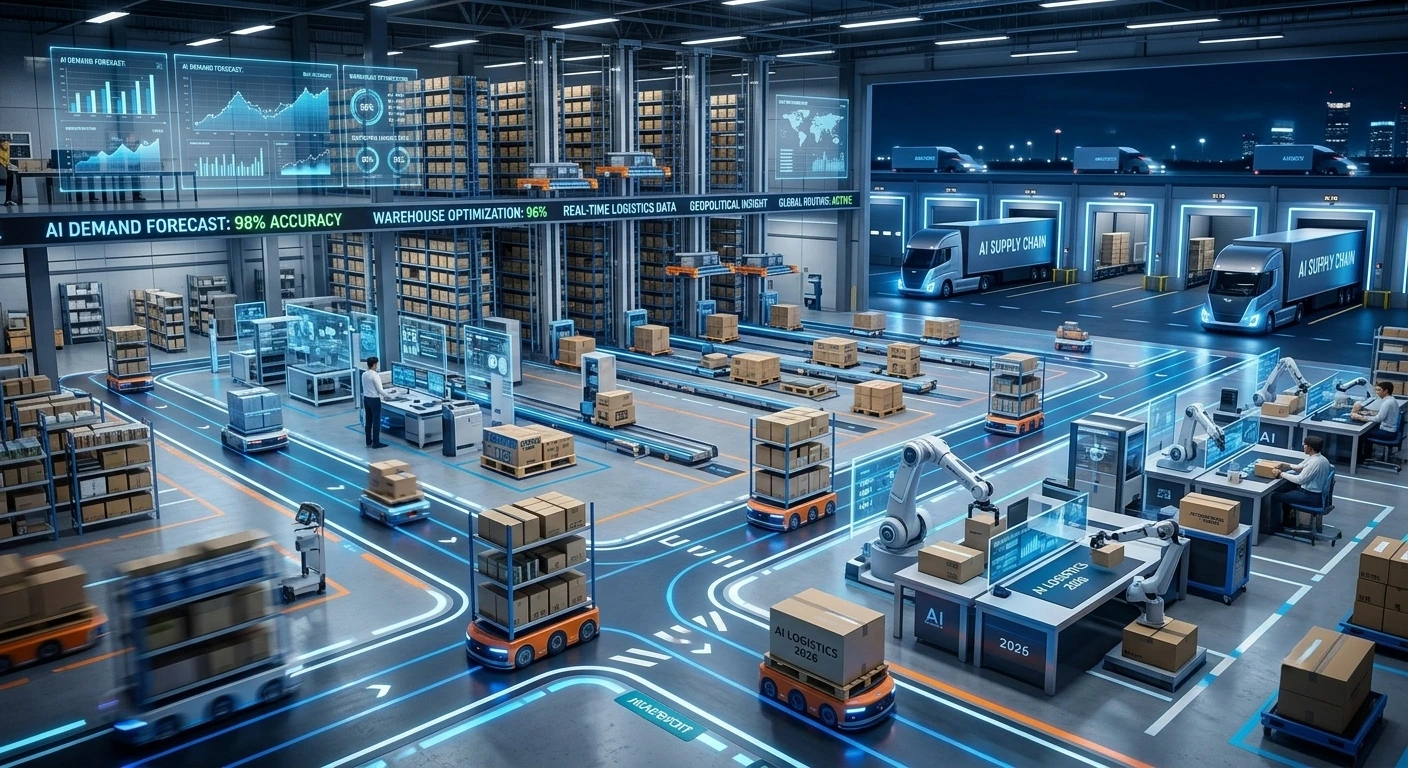
Supply chains in 2026 are under more pressure than at any point in recent memory. Labor shortages, geopolitical disruption, and rising operational costs have made manual processes a liability across logistics, procurement, and inventory management.
The organizations pulling ahead are doing so through supply chain automation. AI now handles demand forecasting, warehouse operations, and procurement decisions at a speed and consistency no manual team can match. This guide covers the key supply chain automation trends shaping 2026, the technologies driving them, and the outcomes companies are already reporting.
Why Supply Chain Automation Is Accelerating
Three structural pressures are pushing supply chain automation to the top of the operations agenda in 2026.
- Labor shortages are a structural, ongoing problem. The US logistics sector faced one unfilled role for every three open positions in 2025, per Emapta. Automation fills those gaps directly in warehouses, fulfillment centers, and planning teams across logistics operations.
- Disruptions are increasing in frequency. 80% of organizations experienced at least one supply chain disruption in 2024. Per Gartner’s 2031 forecast, 60% of supply chain disruptions will be resolved without human involvement by that year, as agentic AI systems take over detection and response.
- Cost pressure is forcing efficiency higher up the priority list. US business logistics costs reached $2.58 trillion. The AI in supply chain market was valued at $9.94 billion in 2025 and is projected to reach $236 billion by 2035, per Precedence Research. That pace of growth reflects how broadly companies now treat automation as a core operational requirement.
Key Supply Chain Automation Trends in 2026
These are the technologies and approaches defining supply chain automation trends in 2026.
Agentic AI and Autonomous Decision-Making
Per Gartner’s 2026 trend report, agentic AI is a top supply chain technology trend for the year, placed first in the “autonomy and agency” theme. The shift is specific: AI is moving away from generating recommendations toward systems that plan, act, and adapt as operations unfold.
Agentic AI systems detect disruptions, evaluate trade-offs across cost and inventory constraints, and execute corrective actions within predefined guardrails. In practice, this covers:
- Rerouting shipments when a supplier or carrier fails
- Re-sequencing warehouse task lists based on real-time demand shifts
- Releasing production orders without waiting for manual sign-off at each step
Gartner also predicts that by 2030, 50% of cross-functional supply chain solutions will use intelligent agents to execute decisions autonomously. Neurotrack builds custom AI agents for supply chain and logistics operations, designed around each organization’s data, systems, and decision workflows. Every build starts with a full process audit to identify where autonomous decision-making delivers the most measurable value.
Warehouse Automation at Scale
Warehouse automation is expanding beyond large enterprise fulfillment centers and into the mid-market. Autonomous robots and machine vision cameras now handle inventory counting, order picking, and goods-in processing at throughput levels that manual labor alone cannot sustain.
Autonomous warehouse robots saw 128.6% growth year-over-year, per ABI Research. Material handling suppliers reported 10–20% annual revenue growth through early 2026. The primary buyers are:
- Retail and e-commerce fulfillment operations
- Food and beverage logistics networks
- Third-party logistics providers facing labor cost pressure
Predictive Analytics and Demand Forecasting
Demand forecasting has moved from monthly planning cycles to continuous, real-time modeling. AI processes multiple data sources at once, including:
- Historical sales data and seasonal patterns
- Supplier lead times and capacity constraints
- External signals such as macroeconomic indicators and weather data
Organizations using AI for demand forecasting report 35% improvement in forecast accuracy and 28% fewer stockouts, per McKinsey and Accenture research. Those gains accumulate across planning cycles and reduce both overstock costs and out-of-stock losses at the same time. Neurotrack integrates custom demand forecasting tools into logistics and retail operations, built around each organization’s own sales history and supply structure.
Procurement Automation
Procurement is one of the fastest-adopting functions in supply chain management. 94% of procurement executives now use generative AI tools at least weekly, per the AI at Wharton and Hackett Group. That figure represents a 44-percentage-point increase year-over-year.
AI handles key procurement tasks without manual input at every step:
- Supplier discovery and qualification
- Contract analysis and risk scoring
- Reorder triggering based on inventory thresholds and lead time data
Neurotrack’s AI business automation solutions cover procurement workflow integration, document processing, and supplier communication as part of broader supply chain builds.
Digital Twins and Real-Time Visibility
Digital twins create live virtual models of entire supply networks, from manufacturing sites to distribution centers. Supply chain leaders use them to:
- Test rerouting decisions before committing resources
- Identify capacity constraints before they become operational problems
- Model the financial impact of a disruption scenario in real time
Only 6% of organizations currently have full end-to-end supply chain visibility. AI-powered control towers built on digital twin models report an average ROI of 307% within 18 months, per published enterprise research. Intelligent simulation, also identified in Gartner’s 2026 supply chain technology trends, extends this by integrating AI directly into planning models to improve forecasting and logistics decision-making.
Supply Chain Automation Trends in Retail
Retail leads AI adoption across all industries. 83% of retail and e-commerce companies have integrated AI into their supply chains. The top 30 North American retailers are nearly all deploying automation, and those that adopted it gained more than 700 basis points of market share since 2019, per Prologis.
Supply chain automation trends in retail in 2026 center on three areas:
- Inventory optimization at the store and warehouse level uses AI to replenish stock based on real-time sales data, cutting overstock and missed demand at the same time.
- Fulfillment automation handles pick-pack-ship cycles faster and with fewer errors than manual processes allow.
- Last-mile delivery planning uses AI to reduce route time and fuel costs simultaneously, where operational efficiency gains translate directly into margin improvement.
For retail and logistics operations managing high volumes of customer inquiries about orders and delivery, an AI chatbot handles those conversations at scale without adding support headcount.
Business Outcomes from AI in Supply Chain
AI-mature supply chains consistently outperform those running on manual processes and legacy planning tools. Measured results from published research include:
- 12.7% reduction in logistics costs and 20.3% lower inventory levels, per McKinsey research on companies with deployed AI in supply chain operations
- 65% higher service levels among organizations using AI within supply chain management, per SCM research data
- 23% higher profitability for companies with AI-mature supply chains versus industry peers, per Accenture 2024 data
- 307% ROI within 18 months for organizations running AI-powered supply chain control towers
For operations teams coordinating across suppliers, carriers, and warehouses, automated meeting summaries reduce the time lost to manual follow-up after planning calls. For voice-based logistics coordination, an AI voice assistant handles routine order status checks and dispatch updates without tying up operations staff.
Conclusion
Supply chain automation trends in 2026 mark a structural change in how organizations manage logistics. AI has moved from a planning aid to an operational layer that makes decisions, adapts in real time, and scales without proportional increases in headcount. Companies that treat automation as permanent infrastructure are already seeing it reflected in margins and service levels. The performance gap between early adopters and those still on manual processes grows wider every quarter.


