Reports are compiled by hand
Data from several systems is merged into spreadsheets for hours every week.
Solutions · Analytics and reports
The solution pulls data from your systems and builds consolidated reports with no manual work. Managers see current metrics instead of spending days compiling spreadsheets.
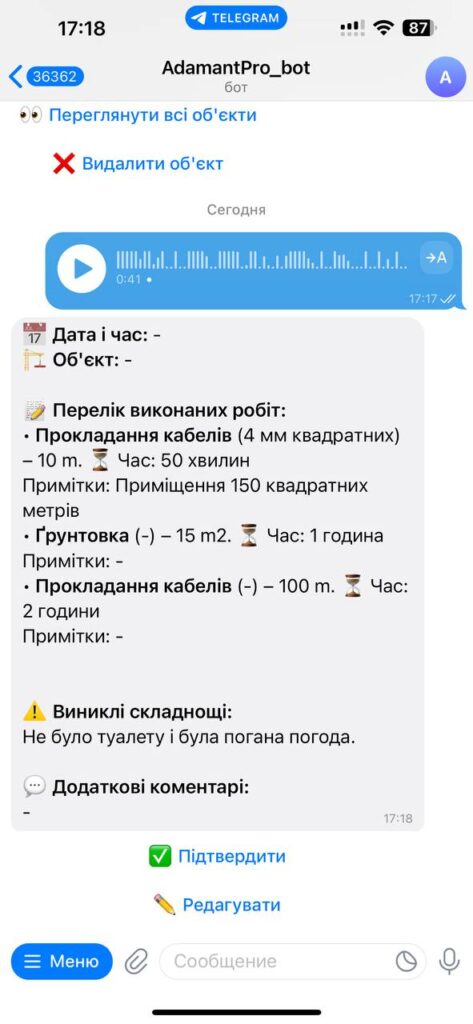
Compiling reports by hand takes hours every week: data is gathered from several systems, moved into spreadsheets, and reconciled. By the time a report is ready, the numbers are already stale, and manual transfer adds errors. Reporting automation removes this step: the solution collects data from your services and task managers and builds consolidated reports from a set template. Managers see current metrics at any moment instead of waiting for the end of the week. Employees can even submit reports by voice — AI turns the dictation into text and structures it. Deadline reminders and role-based access keep the process under control. The solution suits executives and managers, construction, service, and logistics companies, and IT and project teams that need analytics and reporting without compiling spreadsheets by hand.
The problem
Data from several systems is merged into spreadsheets for hours every week.
By the time a report is ready, the numbers no longer match reality.
Manual data transfer adds inaccuracies to reports.
What you'll get
The solution pulls data from your services and task managers.
All metrics in one report from a set template.
Data updates without manual compiling.
Employees can dictate reports, and AI structures them.
Automatic alerts about due dates and tasks.
Managers see the summary; employees see their own data.
What's included
We clarify which metrics managers need.
We collect data from your systems and task managers.
We set up consolidated reports for your tasks.
If needed, employees submit reports by voice.
Automatic alerts about deadlines and tasks.
Managers see the summary; employees see their own data.
Industries
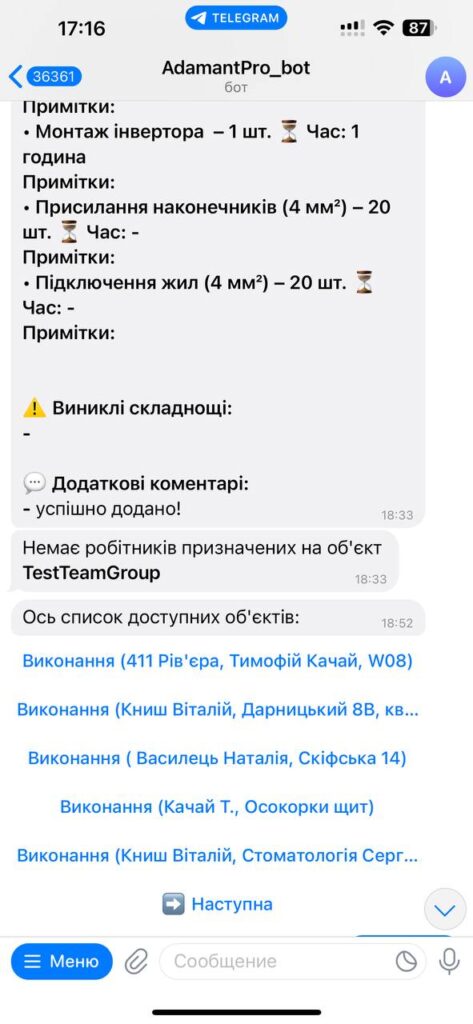
Voice reports from sites: a worker dictates, AI structures it, and the manager gets a finished report.
Consolidated reports on trips, delivery statuses, and completed work without manual compiling.
Track completed tasks and employee productivity in consolidated reports.
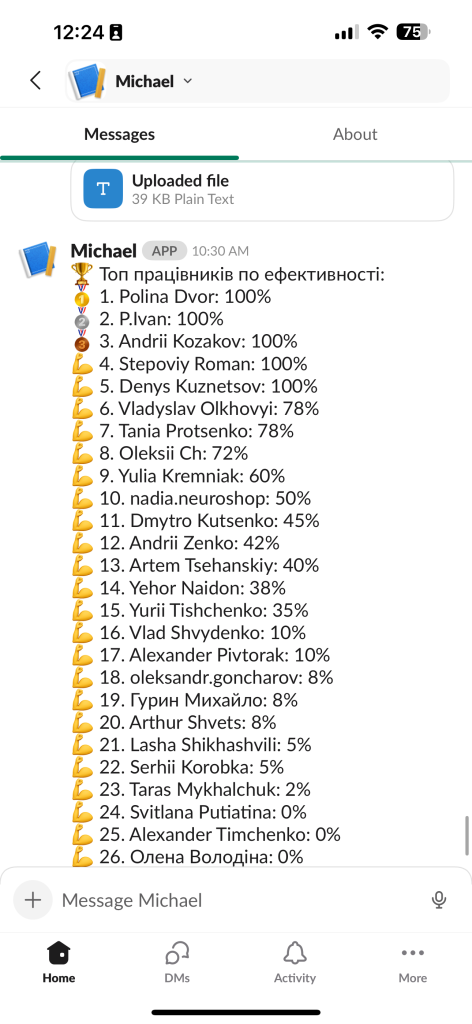
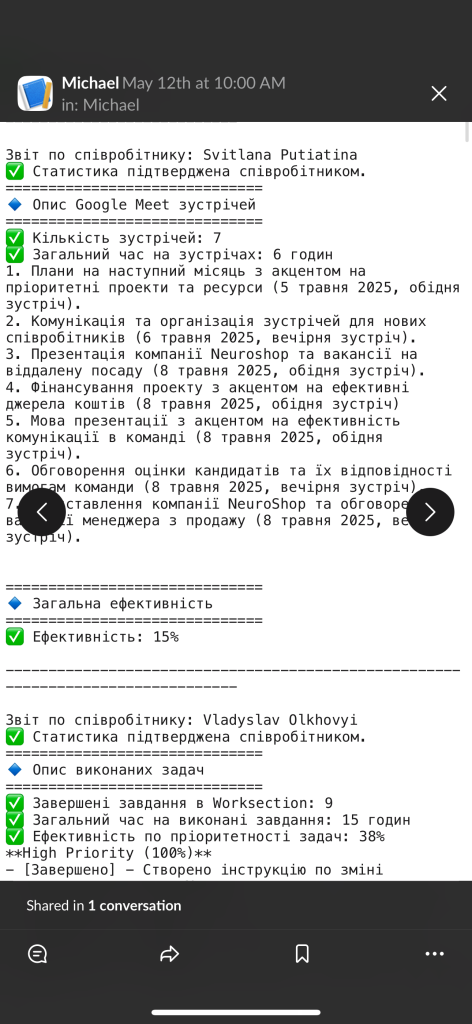
Collects data from Slack, Worksection, and Jira and analyses meeting participation.
Current metrics in real time instead of waiting for a report at the end of the week.
Logging of events and statuses at sites with structured reports.
How we implement it
We clarify which data and metrics you need in the reports.
We collect data from your systems and task managers.
We build consolidated report templates for your tasks.
You get current reports and alerts automatically.
Results
up to 60% — less reporting time (voice AI reports)
AdamantPro case studyup to 50% — less load on managers
Neuroshop case study−70% — time analysing team performance
Neuroshop case studyCase studies
Pricing
Final cost depends on scope and integrations. We'll give exact pricing and timelines after a free consultation.
Why us
In the AdamantPro case, voice AI reports cut reporting time by up to 60%.
In the team-tracking case, up to 50% less, and 70% less analysis time.
We integrate with Slack, Worksection, Jira, and other services.
Data is visible only to the people it is meant for, with permission control.
FAQ
From your systems and task managers. In the team performance tracking case, data was collected from Slack, Worksection, and Jira.
In the project for AdamantPro, voice reports structured by AI cut reporting time by up to 60%.
Yes. An employee dictates a report, AI converts it to text and builds a structured document for the manager.
Access is set by role: managers see the summary, employees see their own data.
In the team performance tracking case, automated reports and reminders cut the load on managers by up to 50% and analysis time by 70%.
The solution starts from $2,000, and support from $150/mo. The cost depends on the number of data sources, report complexity, and integrations — send a request for a quote.
With the task managers and services where your data lives: in our projects these included Slack, Worksection, and Jira. We connect other systems through an API.
Access to reports is separated by role, and Neurotrack protects information in line with international standards.
Reporting automation is when the data for reports is collected and consolidated without manual work. Instead of exporting spreadsheets from different systems every week and merging them by hand, the solution pulls data from your services, task managers, and databases on its own, then builds consolidated reports from a set template. It works in a few steps: first you decide which metrics managers need; then you connect the data sources; then you set up report templates and access rules. After launch, reports update automatically, and alerts remind you about deadlines and open tasks. In Neurotrack projects, data was collected from Slack, Worksection, and Jira, among others, and employees submitted reports by voice — AI turned the dictation into structured text. This approach gives managers current analytics in real time and frees up the time that used to go into manually compiling and checking reports.
Other solutions
Free consultation
In the consultation we'll walk through your process, show similar rollouts, and give you pricing and timelines. The first consultation is free.
What you'll get from the consultation
We use cookies for analytics and advertising to understand how the site is used. You can accept or reject them; see our privacy policy for details.