The line is busy
Customers can’t get through at peak times and after hours.
Service · Voice AI assistant
The assistant understands what the customer says and wants, and replies in a natural voice. During the call it pulls data from your CRM, updates records, and triggers the processes it needs.
A voice AI assistant understands what the customer says and wants, and replies in a natural voice — without a “robotic” sound. During the call it pulls data from your CRM, updates records, and triggers the processes it needs, so the customer gets an answer right away instead of waiting for an operator.
The assistant works where the line is often busy: it takes routine questions (balance, status, booking), handles outbound calls, and can run sales conversations by your scripts. Everything said is recorded in the system without manual entry.
The solution fits retail, financial services, healthcare, software companies, and security companies — anyone who needs a live voice line without growing headcount.
The problem
Customers can’t get through at peak times and after hours.
Balance, status, booking — the same thing dozens of times a day.
After a call, nothing reaches the CRM without manual entry.
What you'll get
Turns spoken words into text in real time.
Interprets the meaning of the request and the context of the conversation.
Speech synthesis without a “robotic” sound.
Remembers what was said across a multi-step conversation.
Connections to CRM and databases, with record updates.
Conversations are built around your processes, with analytics.
What's included
Turns spoken words into text in real time.
Interprets the meaning of the request and the context of the conversation.
Speech synthesis without a “robotic” sound.
Remembers what was said across a multi-step conversation.
Pulls data, updates records, and triggers processes during the call.
Conversations are built around your processes, with analytics.
Industries
A voice line: balances, site status, transfer to an operator.
Order status and routine questions with no queue.
Account and service information with customer identification.
Booking and rescheduling appointments by voice, around the clock.
Outbound calls that find interested customers, following your script.
An AI voice assistant for business is a conversational system that talks to customers in a natural voice and gets things done during the call. It combines speech recognition, natural language understanding, and speech synthesis, so the assistant understands what a caller wants and answers like a person — not through a menu of buttons.
Unlike a push-button voice menu, an AI voice assistant holds a real conversation: it asks clarifying questions, keeps the context across several turns, and drives the request to a result. While the caller is still on the line it reads from your CRM and databases, updates records, and starts the processes the request needs. Companies deploy a voice assistant to take routine calls, run outbound and sales conversations, and keep a live line open around the clock without adding headcount.
Turns what the caller says into text in real time.
Works out the meaning of the request and the context of the conversation.
Replies with speech synthesis, without a “robotic” sound.
Remembers what was said earlier in a multi-step conversation.
Voice automation turns a phone line into a process: the voice assistant answers, handles the routine part of the call, and passes a person only what actually needs a person. We build it as a voice automation platform that connects to your CRM, your telephony, and your company databases, so the assistant can look up a record, update it, and trigger the next step while the caller is still talking.
Through these integrations an automated voice assistant works across the whole request, not just the greeting: it identifies the caller, reads balances or order status from your systems, logs the request as a task, and hands complex or urgent cases to an operator with the full context. The same platform runs inbound support, outbound calls, and sales conversations by your scripts, so voice automation scales across teams and across the enterprise without extra headcount.
The assistant reads and updates records and creates tasks during the call.
Works with your existing phone line and transfers calls to an operator when needed.
Inbound support, outbound calls, and sales run on the same voice automation platform.
Routine calls are automated end to end; complex ones go to a person with the context.
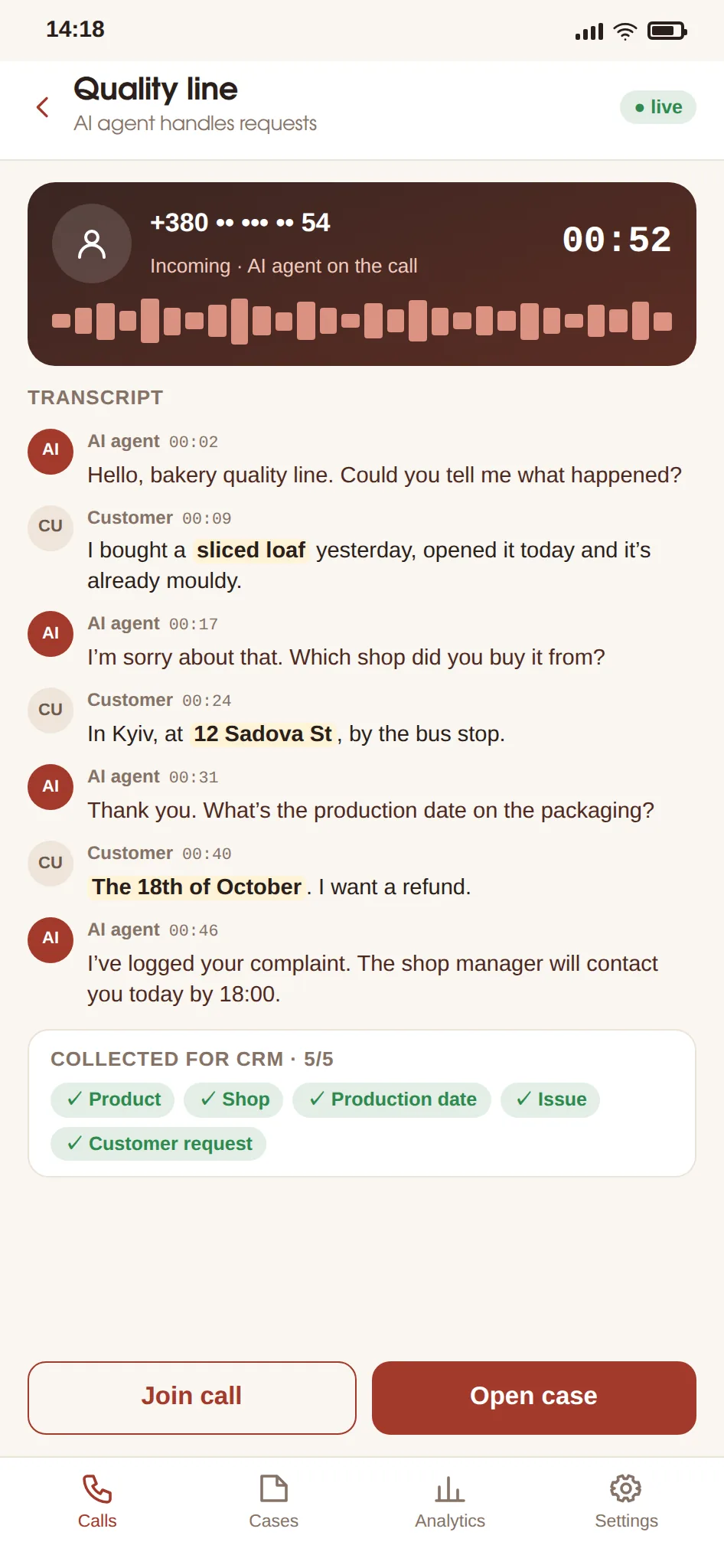
Most hotline calls are routine: a complaint about a product, a question about an order, a request. An agent doesn’t need to solve them — just note the details and log the request. But at peak times there aren’t enough hands, and some calls get lost.
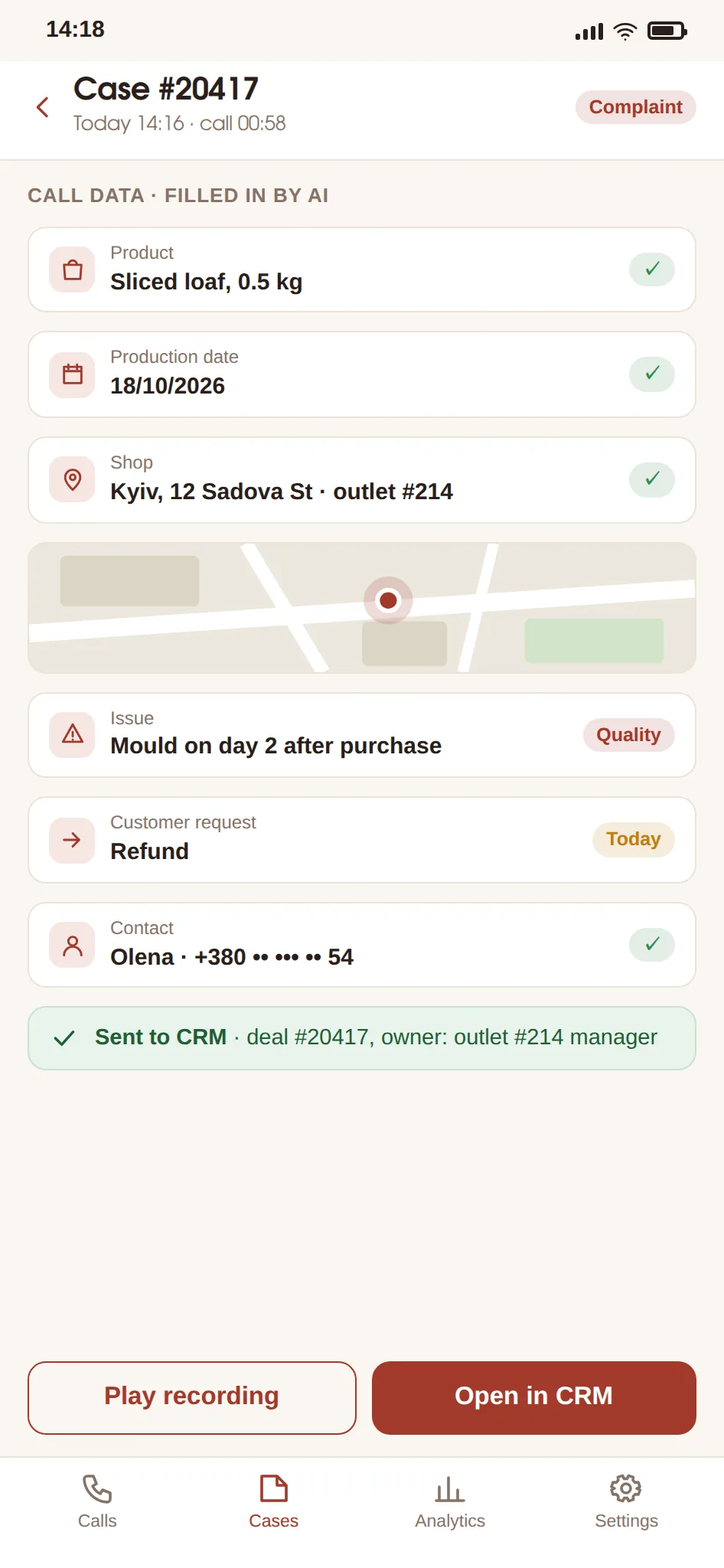
The assistant takes these calls off your team. It accepts the complaint or request, asks what happened, where, and which product is involved, and creates a task in your CRM. Complex or urgent cases go straight to a human operator, along with the context of the call.
For Kulinichi, the AI line takes complaints and passes requests to the CRM — complaint and request handling became five times faster. For Sheriff, the load on agents dropped by up to 60%, and requests are handled three times faster.
Answers the call and follows your script.
Finds out what happened, at which location, and with which product.
The request lands in the system in a structured form, with no retyping.
Urgent and unusual calls go straight to a human operator, with context.
A voice assistant for a company has to work inside your systems, not next to them. We connect it to your CRM, your telephony and your company databases. During a call the assistant sees who is calling, pulls the data it needs, updates records and creates tasks, so nobody retypes anything after the call.
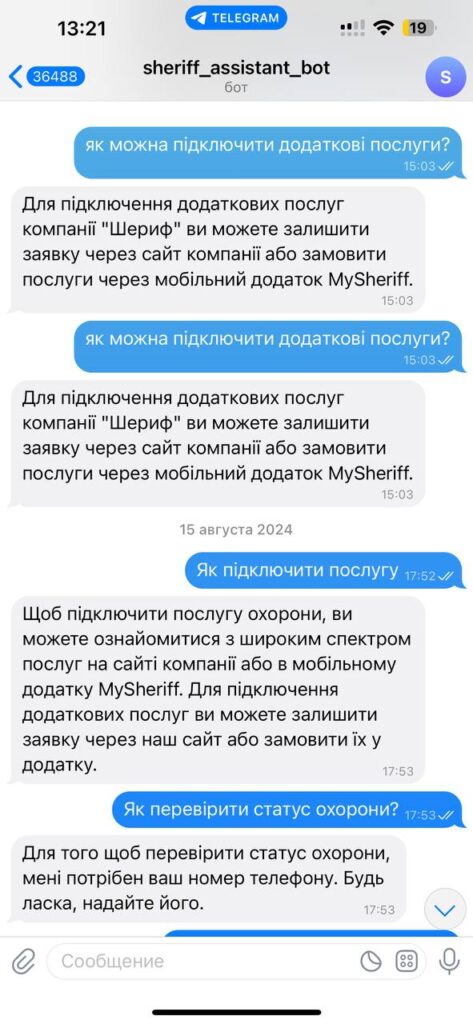
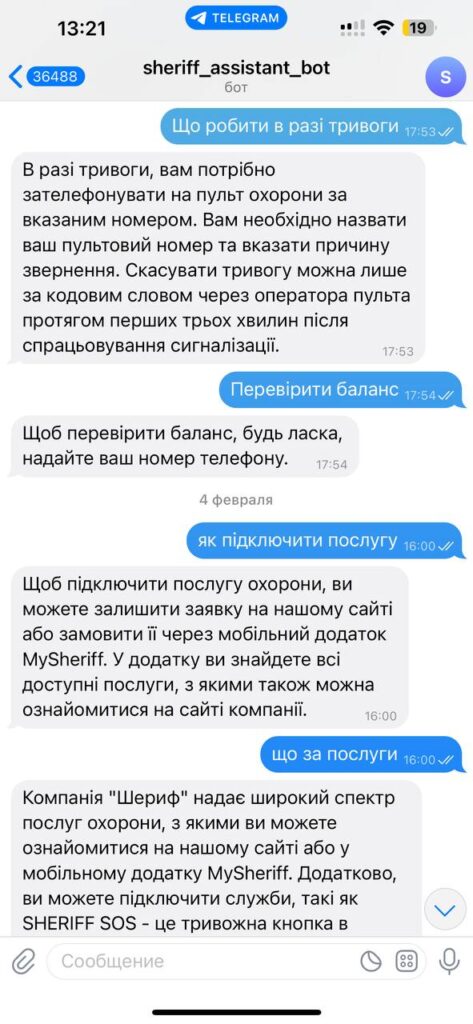
For the security company Sheriff, the assistant recognises the caller through the CRM and database, reads out the account balance and the status of protected sites, and transfers complex or emergency calls to an operator. Operator load fell by up to 60%, and requests are handled three times faster. For Kulinichi, every complaint call ends up as a request in the CRM, and complaint handling became five times faster.
We build the scenarios around your processes and connect only the systems you need. Development starts at $2,000 and support at $150/mo.
Finds the customer’s record, updates it, and creates tasks during the call.
Takes inbound calls and transfers them to an operator automatically or manually.
Reads balances, statuses, and bookings from your systems in real time.
Complex and urgent calls go to an operator together with what has already been said.
How it works
We map your process and define the scenarios and the numbers we’ll judge the result by.
We design the solution and the connections to your systems.
We build the solution and validate it on real data and conversations.
We put it into operation, train your team, and improve it based on results.
Results
up to 60% less load on agents
Case study: Sheriff3× faster request handling
Case study: Sheriffup to 70% less time handling customer requests
Case study: Sheriff5× faster complaint and request handling
Case study: KulinichiCase studies
 Sheriff
Operator load cut by up to 60%.
SheriffCustomer request handling time cut by up to 70%.
View case study Kulinichi
Complaint and request handling speed grew fivefold
View case studyPricing
Final cost depends on scope and integrations. We'll give exact pricing and timelines after a free consultation.
Client testimonial
SheriffWe needed to optimise our customer support operations and automate the handling of customer inquiries. The AI independently responds to routine requests, instantly passes critical issues to a manager, and routes technical inquiries to the appropriate department. We also integrated the solution with our CRM and internal systems (Pult and COC).
The project was implemented in phases, allowing us to thoroughly refine every process and achieve excellent results. Our customer support team now operates far more efficiently, and we are completely satisfied with the collaboration.
 Maryna HryshaiHead of Customer Support, Sheriff
Why us
We launched voice telephony for the security company Sheriff.
A live, natural voice, not a menu of buttons.
Reads and updates CRM records during the conversation.
From inbound support to sales calls.
FAQ
Three steps: it turns what’s said into text, the AI works out what the customer is asking, and the assistant replies in a natural voice.
Yes. The assistant connects to your CRM and corporate databases, and can trigger processes and update records.
Yes. Scenarios are built around your task — from inbound support to sales calls.
Development starts at $2,000 and support at $150/mo. The final cost depends on the scenarios, call volume, and integrations — send a request for a quote.
Yes. The assistant speaks in a natural voice without a “robotic” sound, and the dialogue flows freely rather than through a menu of buttons.
A voice assistant is the phone channel. AI for call centres also adds chat, routing calls between operators, and quality control for an entire support line.
Yes. The assistant answers calls with complaints and requests, finds out what happened, where, and with which product, and logs the request. For Kulinichi, complaint and request handling became five times faster.
The assistant creates a task in your CRM with all the details from the call, so managers don’t retype anything. Complex or urgent cases are passed to an agent during the call, with the context.
Your CRM, your telephony, and your company databases. For Sheriff, the assistant recognises the caller through the CRM and database and reads out the balance and site status during the call. For Kulinichi, every request goes straight into the CRM.
Yes. We connect the assistant to your telephony and CRM so that call data syncs with customer records. When a person is needed, the call is transferred to an operator automatically or manually.
There is no single best platform — the right enterprise voice assistant is the one built around your calls, your CRM, and your telephony. We build a custom voice automation platform for your scenarios and connect it to the systems you already run, instead of fitting your process to an off-the-shelf tool.
We build voice assistants that integrate directly with your CRM and company databases. During a call the assistant finds the customer’s record, updates it, and creates tasks, so call data syncs with your CRM without manual entry.
A voice AI assistant works in three steps: it turns what the customer says into text, the AI works out what they are asking, and the assistant replies in a natural voice. During the call the assistant reaches into your CRM and databases — checking status, balance, or a booking — and can update records and trigger processes.
Unlike an ordinary push-button voice menu, the assistant holds a free-flowing conversation: it asks clarifying questions, remembers what was said earlier, and drives the request to a result. It passes complex or urgent cases to an agent along with the context.
The voice assistant is part of the “AI for call centres” area: if you need voice and chat at once, quality control, and routing calls between operators, see that service. A standalone voice assistant is the choice when the task is specifically a phone line or sales calls.
Other services
Free consultation
In the consultation we'll walk through your process, show similar rollouts, and give you pricing and timelines. The first consultation is free.
What you'll get from the consultation
We use cookies for analytics and advertising to understand how the site is used. You can accept or reject them; see our privacy policy for details.