Data changes daily
Prices, stock and listings update constantly, and you see it too late.
Service · Data monitoring
Competitor prices, delivery app menus and marketplace listings change every day, faster than anyone can check by hand. The system collects the data on a schedule and alerts you, so you can act before revenue slips.
A lot of commercial decisions rely on data held outside your business: competitor prices, your listings on delivery apps and marketplaces, stock availability and new reviews. It changes daily, and if checks are manual, changes are spotted late, after the revenue has already gone. Web scraping and data monitoring replace those checks. The system visits your chosen sources on a schedule, picks up the fields you need and gathers them in one dashboard. When something important moves (a listing vanishes, a price jumps, a new review appears), the right person is alerted straight away. This is the umbrella service for several jobs: competitor price monitoring, tracking menus on delivery apps and keeping an eye on marketplaces. It suits retail, e-commerce, food businesses, manufacturers and distributors. Menus on Glovo and Bolt Food have a dedicated page, based on our Simeyna Pekarnya project.
The problem
Prices, stock and listings update constantly, and you see it too late.
Someone opens websites and seller dashboards and compares everything by eye.
Until someone notices a change, sales drop or you lose on price.
Prices, stock and reviews sit in different sources with no single view.
The more sites, products and locations, the harder it is to track by hand.
What you'll get
The system visits your sources and gathers the data itself.
Notifies you the moment a price, stock level or listing changes.
All collected data in a single table or dashboard.
Shows where you are pricier or cheaper than the market.
Tracks your listings and positions on each platform.
Keeps a record of what changed and when, for analysis.
Shows price and stock trends over a week or a month.
What's included
Sites, dashboards and fields to track.
What to collect and how often.
Who receives signals, and where.
Data in one table or dashboard.
What changed, and when.
We test on your sources and support you after go-live.
Industries
Competitor price monitoring and tracking your own listings, so you react to promotions in time and do not lose on price.
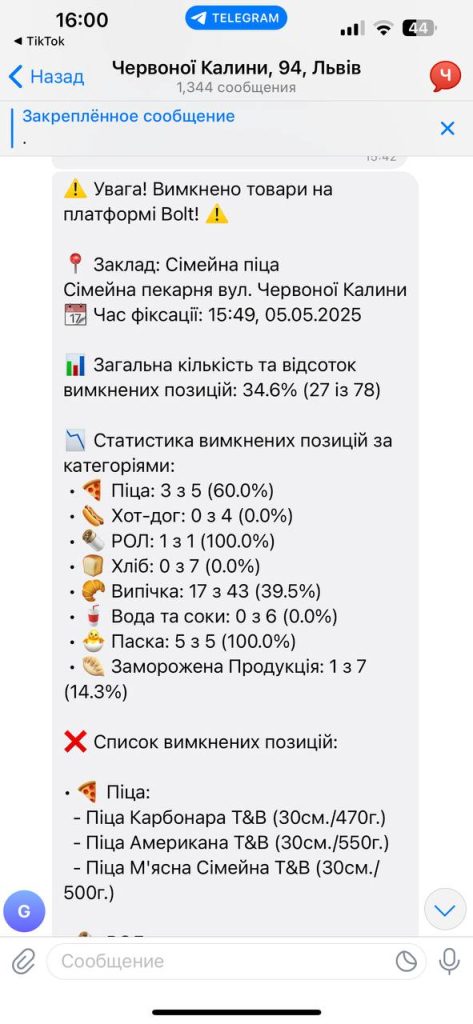
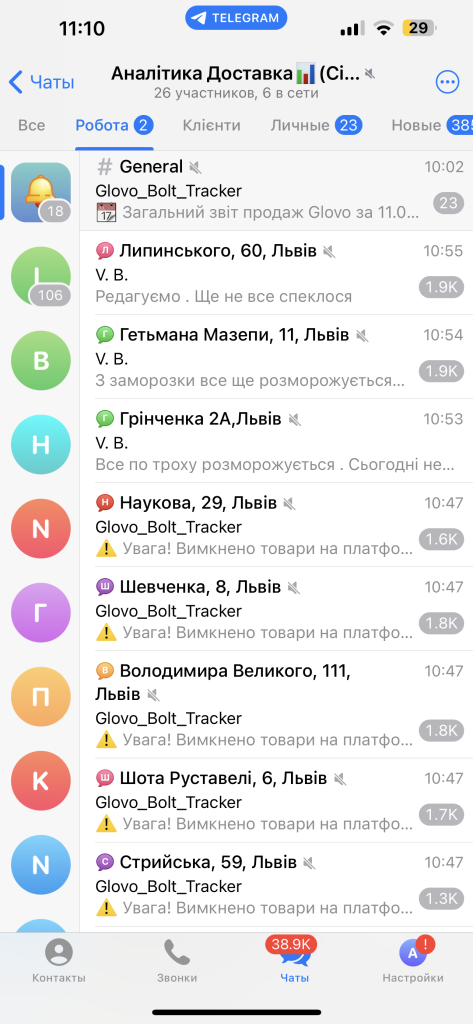
Menu tracking on delivery apps, as at Simeyna Pekarnya, where manual checks dropped by 90%.
Tracking stock, prices, search position and new reviews on your listings.
Checking what price partners sell your products at on different platforms.
Regular market data collection for decisions instead of one-off manual exports.
When competitors change prices every day, there is no keeping up by hand. The system visits the sites you choose on a schedule, collects prices for your products and shows where you are more expensive or cheaper than the market.
The data lands in one table or dashboard, and sharp changes arrive as alerts. Your sales team sees the price picture every day, not once a month, and has time to respond to competitors’ promotions.
Competitor prices checked daily or more often.
See where you are pricier or cheaper than the market.
Sharp price changes arrive as a message.
On a marketplace, price is only part of it. What also matters is whether the listing is live, where it ranks in search and what new reviews say. If a listing disappears or an item sells out, sales drop, and nobody notices right away.
Monitoring tracks your listings and competitors’ listings: prices, stock, rating and fresh reviews. The person in charge gets a signal as soon as something changes and has time to fix the listing or reply to the review.
An alert if an item vanishes or runs out.
Tracking prices and the listing’s place in search.
Fresh product reviews go straight to the person in charge.
How we implement it
We decide which sites, dashboards and fields to track.
We define what to scrape and how often.
We set up signals and a summary of the collected data.
The system collects data, you get alerts, and we support it.
Results
−90% — fewer manual menu checks
Case study: Simeyna Pekarnya$1,000+ — revenue recovered per month
Case study: Simeyna PekarnyaPricing
Final cost depends on scope and integrations. We'll give exact pricing and timelines after a free consultation.
Why us
The alert arrives when the change happens, not a week later.
At Simeyna Pekarnya, manual menu checks dropped by 90%.
There, the business recovers $1,000+ in lost revenue every month.
Prices, menus and marketplaces in a single collection process.
FAQ
Competitor prices, your menu on delivery services, marketplace listings (stock, prices, search position and new reviews). We set the system up for the sources and fields you need and bring the data into one dashboard with change alerts.
On a schedule we set for the task, from several times a day to every hour. In the Simeyna Pekarnya menu monitoring case, the system checks listings hourly and alerts the manager as soon as a dish becomes unavailable.
Menu monitoring on Glovo and Bolt Food is a narrow solution for food businesses. This page is broader: it also covers competitor prices and marketplaces. If you only need menus on delivery apps, go to that separate solution page.
Wherever it is easiest for you to follow them: a messenger or email for the person in charge. We set the channel and recipients for you, so a signal about an important change does not get lost.
Roughly 4–8 weeks from kickoff to a working setup. The exact timeline depends on the number of sources, the volume of data and how complex the alerts and dashboard are.
Yes. We agree on the list of sources and products, and the system collects prices from them on a schedule and compares them with yours. If a site’s structure changes, we adjust collection as part of support.
We choose a proper collection method for each source. If data is not available automatically, we discuss alternatives (official exports, an API or other sources of the same data) so you are not left without the numbers you need.
Implementation starts at $2,000 and support at $150/mo. The final price depends on the number of sources and fields and how often data is collected. Leave a request and we will prepare a free estimate.
Data monitoring and web scraping mean automatic collection of the outside information you need for decisions: competitor prices, your listings on delivery apps and marketplaces, stock levels, fresh reviews. Instead of opening websites and seller dashboards by hand, you get combined data in one dashboard and a signal as soon as something important changes. It works in a few steps. First we review the sources and decide which fields to track. Next we set up collection: what to scrape and how often. Then we define who gets alerts and where, and bring the data into a table or dashboard with change history. The more data and sources you have, the more each missed change costs, and the more value monitoring brings. This parent service covers several jobs: competitor price monitoring, menu tracking on delivery services and marketplace monitoring. We moved the narrow case of menus on Glovo and Bolt Food into a separate solution based on the Simeyna Pekarnya case: there the system checks listings every hour, manual menu checks fell by 90%, and the business recovers $1,000+ in lost revenue each month.
Related pages:
Menu monitoring on Glovo and Bolt Food
Other solutions
Free consultation
In the consultation we'll walk through your process, show similar rollouts, and give you pricing and timelines. The first consultation is free.
What you'll get from the consultation
We use cookies for analytics and advertising to understand how the site is used. You can accept or reject them; see our privacy policy for details.