How Multi-Agent AI Systems Work in Business
Contents
- What Are Multi-Agent Systems?
- Single Agent vs Multi-Agent Systems
- How Multi-Agent Systems Work
- The Orchestration Layer
- Common Multi-Agent Orchestration Patterns
- Communication Between Agents
- Business Use Cases for Multi-Agent AI
- Operations: An Agro-Holding Agent Workspace
- Customer Support Routing
- Benefits and Challenges of Multi-Agent Systems
- Benefits
- Challenges
- How to Implement a Multi-Agent System
- Conclusion
Gartner logged a 1,445% rise in enquiries about multi-agent systems between Q1 2024 and Q2 2025. However, when one AI agent handles sales questions and CRM updates from one prompt, tasks get mixed up as tools are added. As a result, your team spends hours checking the output. With multi-agent AI, the same work is split between specialised agents with their own instructions and access rights.
Next, you will see how these setups are coordinated and rolled out step by step at Neurotrack.
What Are Multi-Agent Systems?
Multi-agent systems are AI setups in which several specialised agents work on parts of one business process and pass results to each other. In a multi-agent architecture, one agent is assigned to one task, like invoice checks or lead qualification. Therefore, it gets access only to the tools and data that this task requires.
By comparison, a single AI agent is one program with a language model and tools, as covered in our AI agents for business guide. However, once a process spans sales and finance, one prompt carries all the instructions, and errors become harder to trace.
Single Agent vs Multi-Agent Systems
The two designs differ most in daily operation, especially in how instructions and data access are organised:
| Criterion | Single AI agent | Multi-agent system |
|---|---|---|
| Instructions | All rules are kept in one prompt | Rules are split by agent role |
| Data access | One permission set covers all tasks | Permissions are set per agent |
| Error tracing | Errors from all tasks appear in one log | Errors are traced to a specific agent |
For this reason, a single agent fits one channel or document type. Multi-agent workflows pay off when a process crosses CRM and ERP and needs separate access rules per step.
How Multi-Agent Systems Work
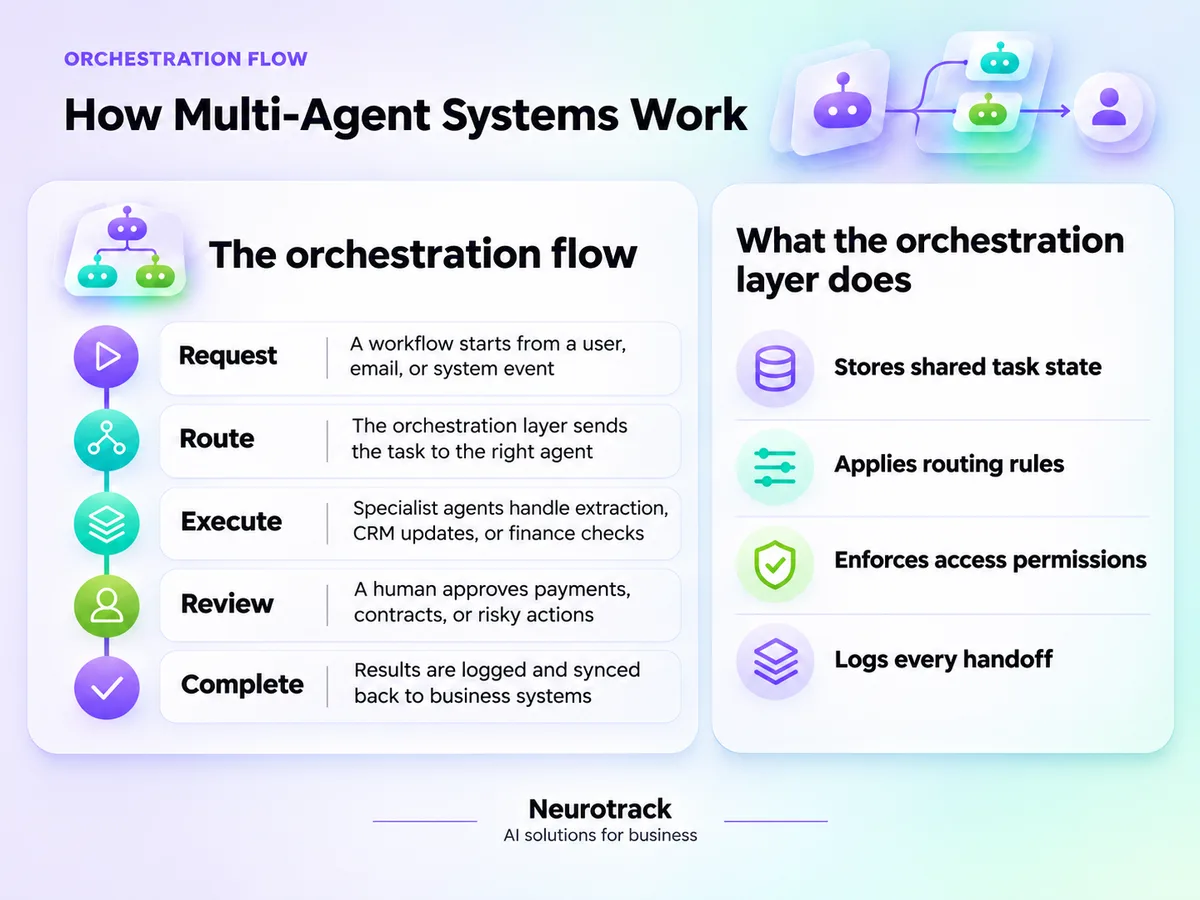
Through AI agent orchestration, your team sets which agent receives a task and when a person approves the result.
The Orchestration Layer
The orchestration layer stores the shared task state and the routing rules between agents. Permissions are enforced at this layer, so an agent with CRM access cannot write to the accounting system. Accordingly, Gartner noted in October 2026 that value in multi-agent AI is moving to the orchestration layer.
Common Multi-Agent Orchestration Patterns
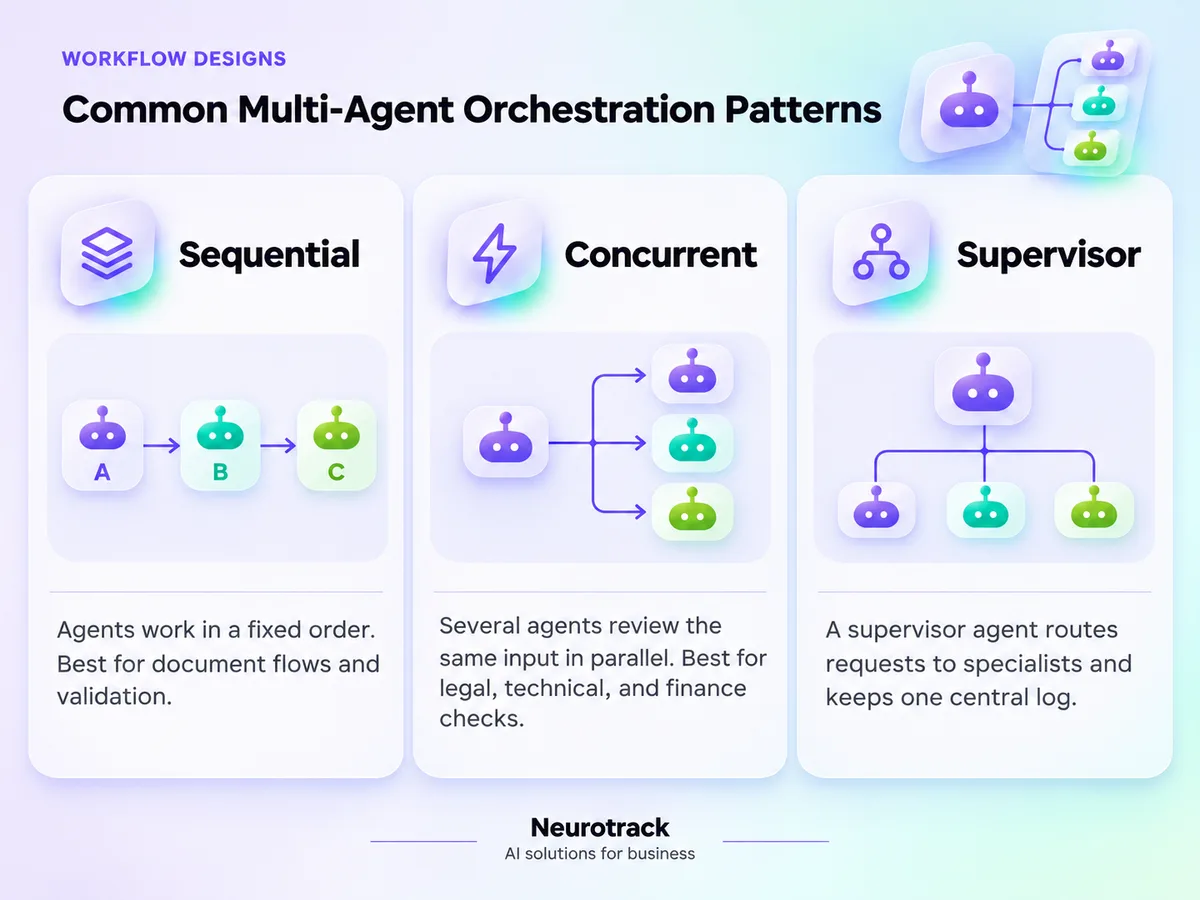
The pattern is chosen by task order and dependencies. In a January 2026 arXiv paper, Marlon Dumas and co-authors describe patterns common in business processes:
- Sequential: Agents work in a fixed order, and one agent's output becomes the next agent's input. This fits document flows, where extraction precedes validation.
- Concurrent: Several agents review the same input in parallel, e.g. legal and technical product checks. As a result, total processing time equals that of the slowest agent.
- Supervisor: A supervisor agent routes requests to specialists, such as billing questions to a finance agent. Routing is logged in one place, but the whole flow stops when the supervisor fails.
These patterns can be combined, e.g. a supervisor agent passes billing requests to a sequential invoice-check flow.
Communication Between Agents
Axios reported in August 2026 that the Agent2Agent (A2A) protocol is moving to the Agentic AI Foundation, which has over 250 members. A2A is the standard for agent-to-agent communication, and the same foundation hosts the Model Context Protocol (MCP) for tool access. As a result, agents from different vendors need less integration code.
Business Use Cases for Multi-Agent AI
Multi-agent AI fits processes that cross several systems and need different access rights per step. The following examples show how enterprise AI agents are split by task.
Operations: An Agro-Holding Agent Workspace
For an agro-holding with data spread across systems such as 1C and SAP, we built an AI agent workspace with separate agents per work area:
- Spare parts: Demand is forecast six weeks ahead, so spare-part shortages are spotted before they lead to machinery downtime.
- Acts and customs: Separate agents reconcile acts and keep the customs register, where staff see only the exceptions that need a decision.
In all areas, agents prepare signals, and a person makes the final decision.
Customer Support Routing
In support, a supervisor agent passes incoming requests to specialists, e.g. a billing or delivery-status agent. With multi-agent automation, escalation rules are set per agent. As a result, a complex case is handed to an operator with the conversation history.
The same handoff to a person is built into our AI solutions for business, including chatbots and voice agents.
Benefits and Challenges of Multi-Agent Systems
With multi-agent systems, data access and error tracing are easier to control. However, coordination becomes the main challenge, because a failure at one handoff affects the next step.
Benefits
With clear rules for AI agent collaboration, your team gets these advantages:
- Separate permissions: Access is granted per agent, so an email agent has no write access to ERP records.
- Easier debugging: Errors are traced to one agent's log, and only that agent's prompt is changed.
- Reusable agents: A document extraction agent can be reused in another workflow without a rebuild.
Challenges
Coordination is the first risk. In the MAST study at NeurIPS 2025, UC Berkeley researchers found 14 failure modes in multi-agent frameworks, from vague roles to missing result checks.
Security is the second concern, since agents act inside business systems. In February 2026, NIST launched the AI Agent Standards Initiative to develop agent security and interoperability standards. Until final standards are published, your team should log all agent actions and keep human approval for payments.
How to Implement a Multi-Agent System
A phased rollout is the safer option, because errors are found on one process at a small volume. One common sequence:
- Pick one process: Choose a cross-system workflow with measurable volume, such as order handling in CRM and ERP, and record a baseline metric.
- Define agent roles: Describe the task and the stop condition per agent, since vague roles were a failure cause in the MAST study.
- Choose the pattern: Use a sequential flow for ordered steps and a supervisor agent for request routing.
- Connect systems: Integrate agents with CRM and ERP through APIs, with minimal permissions per task.
- Add human checkpoints: Set approval steps for payments and contracts, and log agent actions for audits.
- Pilot, then expand: Test on real data at small volume, and add agents once the results beat the baseline.
At Neurotrack, we run AI agent development projects in this order and launch them within 4–8 weeks from kickoff. Integration starts from $2,000 as an indicative price.
Conclusion
In multi-agent systems, one complex process is split between specialised agents that are connected through AI agent orchestration. The orchestration pattern is chosen by task order, and agents exchange data through protocols such as A2A and MCP. With this design, permissions are separated and errors are traced to a specific agent. Coordination and security, however, need checkpoints and logs from the first pilot.
FAQ
What is the difference between a single AI agent and multi-agent AI?
A single AI agent handles one task with one prompt and one set of tools. In multi-agent AI, a process is split between specialised agents, so permissions and errors stay separate and are easier to control.
When does a business need multi-agent systems?
Multi-agent systems are worth considering when one workflow crosses several systems, such as CRM and ERP, and different steps need different access rights. For one narrow task, a single agent is enough.
What is AI agent orchestration?
AI agent orchestration is the set of rules by which tasks are assigned to agents and results are sent for human approval. Common patterns include sequential flows and supervisor agents that route requests to specialists.
How long does it take to build a multi-agent system?
The timeline depends on the number of agents and integrations, and Neurotrack confirms it in the estimate after a free consultation. Enterprise AI agents are rolled out step by step, with one workflow first.