What Is RAG? A Plain-English Guide to RAG vs Fine-Tuning
Contents
RAG is a way to make an AI assistant look up the answer in your company's documents before it replies. It answers from your policies, contracts and knowledge base, not from memory or the open internet. For a business, that means fewer made-up answers and a chatbot you can trust with customers and staff.
Below we explain what RAG is in plain English, how it works, where it helps, and how RAG vs fine-tuning compares. No formulas, no jargon.
What is RAG? RAG explained simply
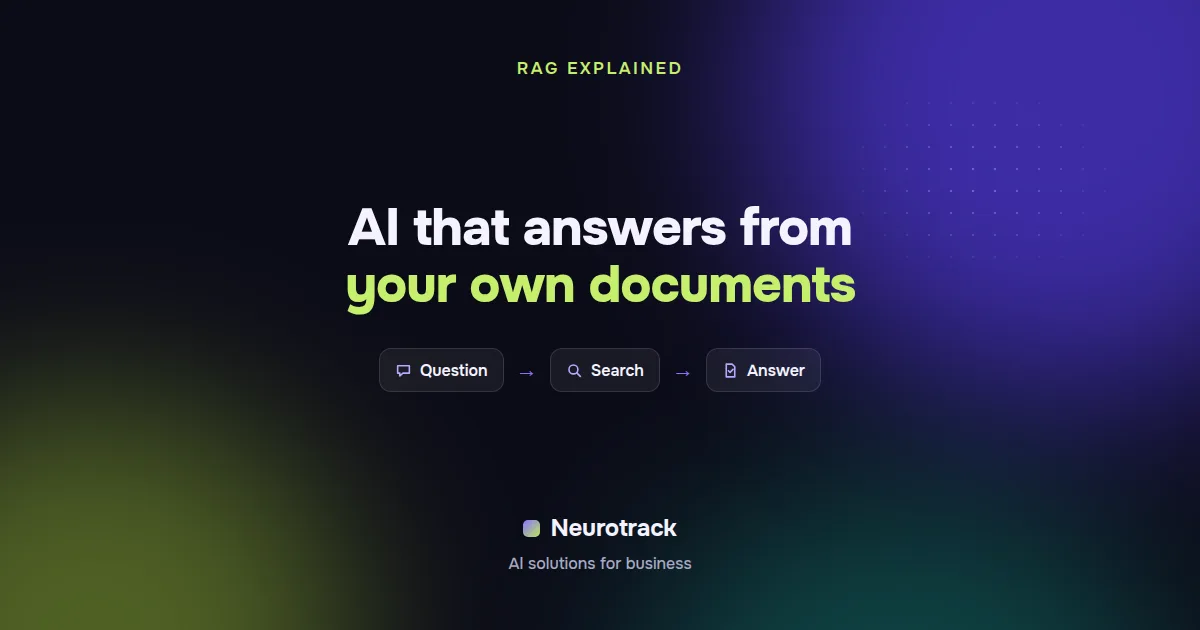
RAG stands for Retrieval-Augmented Generation. Put simply: "find first, then answer". The system searches your documents, and only then writes a reply.
A standard chatbot built on a language model (like ChatGPT) only knows what it saw during training. It has never seen your internal rules. So when asked about your company, it may confidently invent an answer. These inventions are called "hallucinations".
Think of a new starter. They're bright and well spoken, but they don't know your rules yet. You could train them for months. Or you could hand them the staff handbook and agree on one thing: before you answer a customer, find the right page. RAG is the second option.
What this gives you in practice:
- Answers based on your documents. The system shows which document and section each answer came from.
- Knowledge that's easy to update. Change a policy and the bot answers differently. No retraining needed.
- Fewer made-up answers. The model answers from what it found, not from memory.
The approach was described by researchers at Facebook AI in 2020. Since then, it has become a common way for organisations to connect AI to their own data.
How RAG works in 4 steps
Let's take an example. An employee asks the bot: "How do I book time off?"
- Prepare the documents. Gather the sources: the HR policy, manuals, contracts, the knowledge base. PDFs, spreadsheets and web pages all work. The system cuts long documents into short passages, like cards in a filing cabinet. That way it finds the one paragraph you need, not the whole policy.
- Search by meaning. The system doesn't look for matching words. It looks for matching meaning. To do that, it turns every passage and the question itself into a vector, a numeric "fingerprint" of the meaning. Texts with similar meaning get similar fingerprints. So "how do I book time off" finds the section called "Annual leave entitlement", even though the words are different.
- Hand the findings to the model. The system adds the closest passages to the question. The model gets an instruction along the lines of: "Here is the question and here are extracts from the policy. Answer only from these."
- Get an answer with a source. The model writes a short answer in plain English: "Submit a leave request in the HR portal; your line manager approves it." Next to it is a link to the policy section. Anyone can check it in one click.
Where RAG helps a business
RAG is useful wherever an answer should come from your own documents rather than general knowledge.
- Customer support. A customer asks: "What are your delivery terms to my town?" A chatbot built on your knowledge base answers from your current terms. It handles simple questions itself and passes complex ones to a person.
- Help for employees. Annual leave, system access, laptop set-up, internal procedures. People ask in their own words and get an answer with a link to the policy. No waiting for a colleague in the team chat.
- Sales. A sales rep quickly finds product specs, compatibility and supply terms. Instead of scrolling through price lists, they just ask.
- Contracts. A manager asks: "Which contracts include penalties for late payment?" The system finds the relevant clauses across many agreements. The decision stays with a person.
- Reports and documents. Upload a report or a specification and ask questions in plain English. This fits well with document workflow automation.
In every case, your documents remain the source of truth. AI simply gives you an easier way into them.
RAG vs fine-tuning: which to choose
There are three common ways to tailor AI to your work. Here's each in one sentence.
- Prompt engineering means writing a careful prompt, the instruction you give the AI in the request itself. Like a detailed brief to a contractor: quick and cheap, but it only lasts for one conversation.
- RAG means the AI looks up the answer in your documents every time it's asked. Like a colleague with the handbook open on their desk.
- Fine-tuning means extra training of the model on your examples. Like a long training course: the person picks up a style and a way of working, but new rules mean training again.
How they compare:
| Criterion | Prompt engineering | RAG | Fine-tuning |
|---|---|---|---|
| Data freshness | Only what you put in the request | Always current: update the documents and the answers change | Frozen at training time |
| Cost | Lowest | Moderate (search plus storage) | Higher (data prep plus compute) |
| Time to launch | Hours–days | Days–weeks | Weeks (collecting and labelling data) |
| Protection from made-up answers | Low | High: answers link to their sources | Medium: improves style, can still invent facts |
| Data privacy | Depends on the model provider | Data can stay inside your perimeter | Training data leaves a trace in the model itself |
When to use each:
- Prompt engineering for simple, one-off tasks: rewrite a text, draft an email, test an idea quickly.
- RAG when answers must come from your documents, those documents change often, and you need to see the source. For example, a support bot or a search across contracts.
- Fine-tuning when you need a consistent tone, format or narrow task. For example, always answering in your brand voice or sorting incoming requests by type.
RAG vs fine-tuning in one line: RAG controls what the AI knows, fine-tuning controls how it answers. The two are often combined in one solution.
Can RAG get things wrong?
Yes. RAG cuts down on made-up answers, but it doesn't remove them entirely. Here's what to plan for before launch:
- Document quality. Out-of-date or contradictory documents produce out-of-date or contradictory answers. Clear out duplicates and old versions first.
- Search quality. If the system misses the right passage, the answer will be weak. This is tuned and checked against a set of test questions.
- Access rights. The bot must not show an employee what they aren't allowed to see. Access is set per document.
- Updates. New documents need to be added to the search regularly.
- Human review. For important decisions, a person has the final say. A good system honestly says "I don't know" when the data is missing.
Is RAG safe for your data?
For many organisations, the main question is where their documents will go. RAG doesn't require sending them to someone else's cloud.
The system can run on your own servers (this is called on-premise), with models that run locally. Then documents and questions never leave the company. That matters for finance, healthcare, the public sector and legal services.
More on how we protect data is on the security page.
How much does a RAG system cost, and how long does it take?
The price depends on the volume of documents, the number of scenarios, integrations and security requirements. Light solutions start from $2,000 and launch in up to 2 weeks. For guidance by package, see our pricing page.
A sensible start is a pilot on one scenario, such as a support bot or an internal helpdesk. Check the answers on real questions. Then expand to other areas.
Let's look at your case
Tell us about your documents and your goals, and we'll suggest where to start and show how it would work for you. Book a free consultation.
Sources
- Patrick Lewis et al. (2020). "Retrieval-Augmented Generation for Knowledge-Intensive NLP Tasks." arXiv:2005.11401. https://arxiv.org/abs/2005.11401
FAQ
What is RAG, explained simply?
It's AI that looks up the answer in your documents before it replies. It shows the source next to each answer, so you can check it.
What does RAG mean in AI?
RAG stands for Retrieval-Augmented Generation. The AI first retrieves relevant passages from your documents, then generates an answer based on them.
RAG vs fine-tuning: which should I use?
If you need current facts from your documents, choose RAG. If you need a consistent tone or format, fine-tuning helps. The two are often combined.
Can RAG run without sending data to the cloud?
Yes. A RAG system can be deployed on your own servers with local models, and the data stays inside the organisation.
Can RAG make mistakes?
Yes, if documents are out of date or the right passage isn't found. Clean sources, test questions, source links and human review keep the risk down.
How long does it take to implement RAG?
Light solutions launch in up to 2 weeks. More complex ones depend on the volume of documents and integrations.